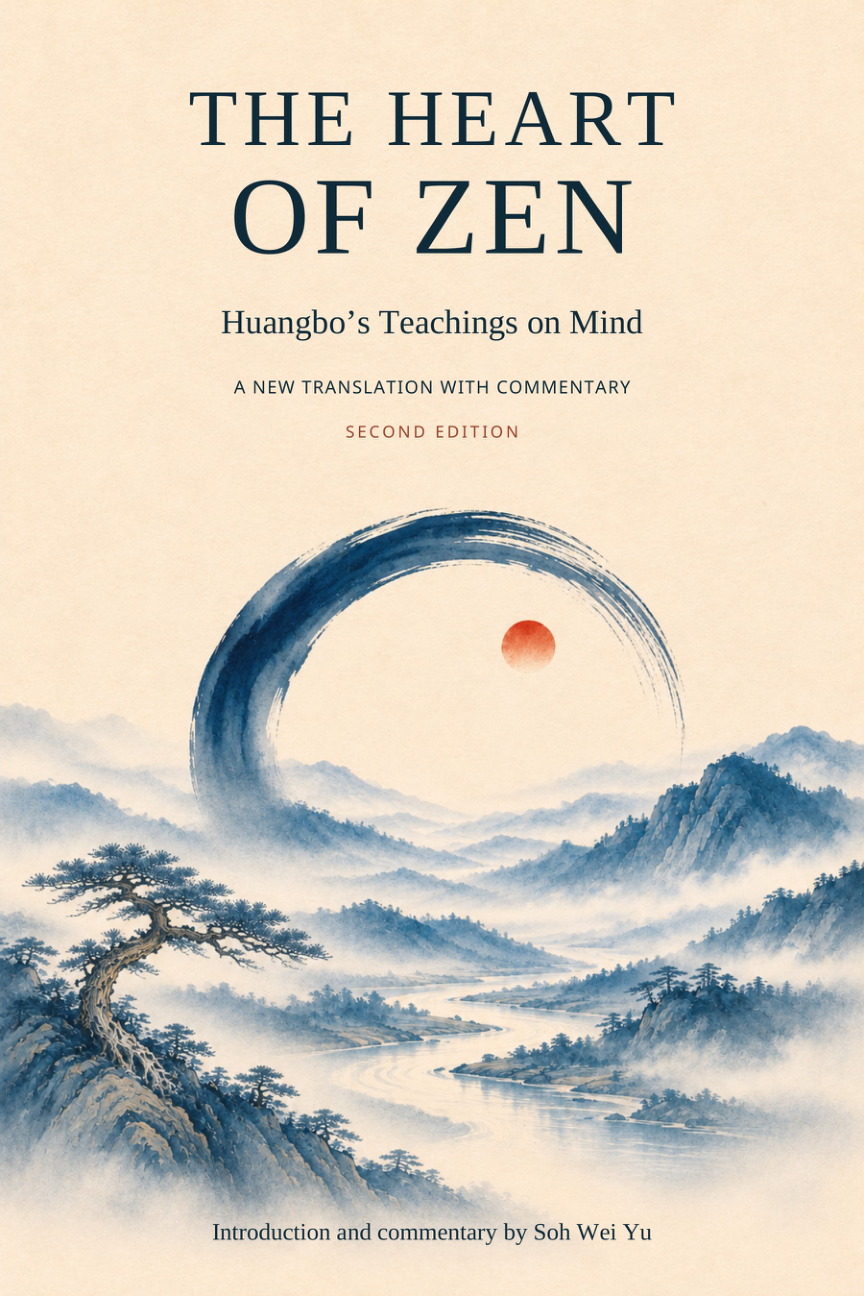
The Heart of Zen: Huangbo’s Teachings on Mind — Second Edition
Second edition · 3 November 2026 · Digital review edition
The Heart of Zen: Huangbo’s Teachings on Mind
A brand-new translation from the original Chinese, with commentary by Soh Wei Yu.
This revised edition brings together Pei Xiu’s Preface, the Essentials of the Transmission of Mind, the Wanling Record, and twenty-eight appended materials, with an introduction, commentary, glossary, source notes, and a reading guide.
Read and download
Download PDFDownload WordDownload EPUB
The current files are the HI017 digital review edition, revised 9 November 2026. The PDF contains 331 pages in a 6 × 9 inch format. Choose Word if you need an editable copy, or EPUB to adjust the text size in your ebook reader.
Edition status: This edition is free to read and study while final checks continue. The PDF, Word and ebook contain the same revised text. Further checks are still needed in Word, on ebook readers and for accessibility, along with independent specialist review and checks of sources and quotation use. It is not yet the final print or retail edition.
About this edition
Huangbo’s teachings repeatedly cut through the effort to grasp awakening as an object, an attainment, or a separate knower behind experience. This edition places a new English translation from the Chinese alongside commentary and notes explaining the sources. The translation is clearly separated from the commentary.
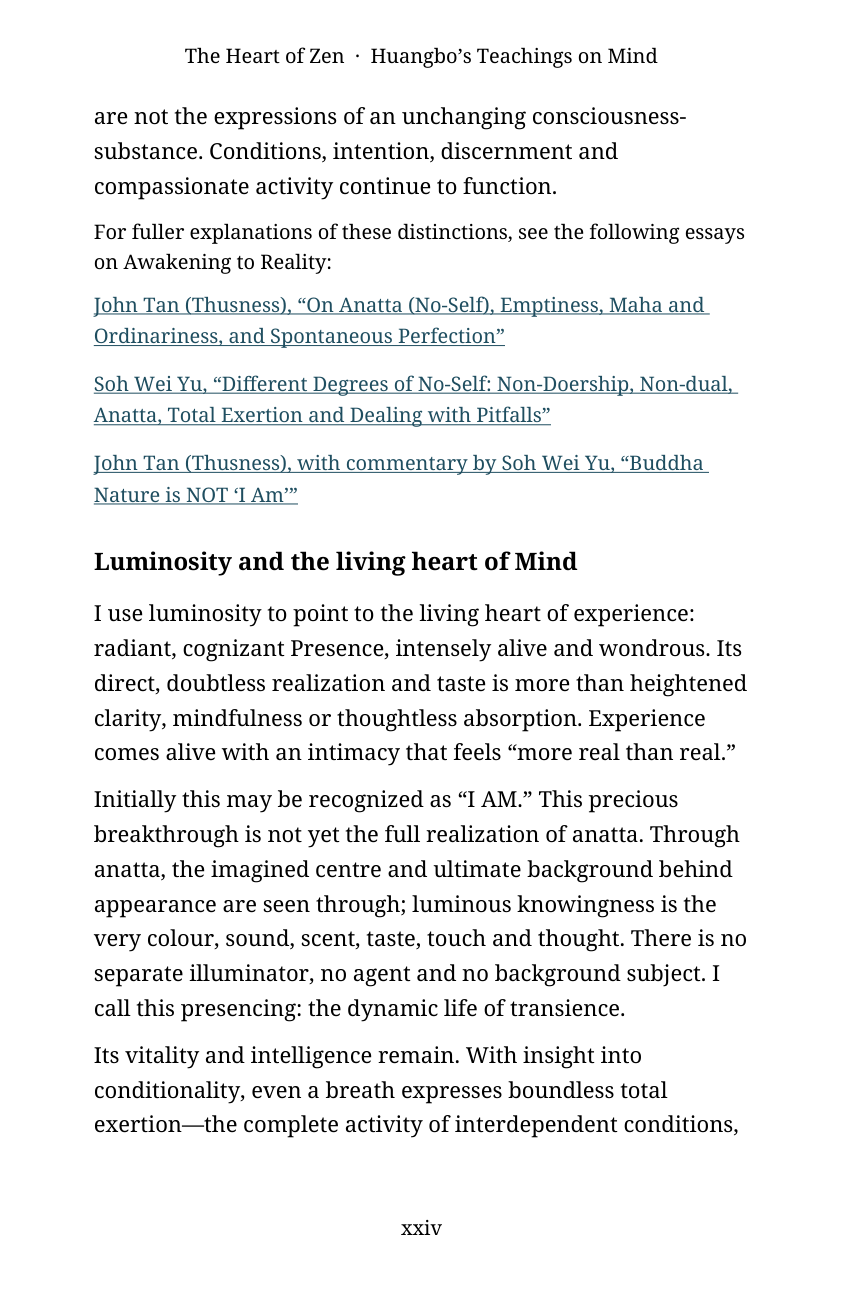
The introduction discusses luminous knowing, the direct realization of Mind, and the further examination of a seemingly independent subject or background behind appearances. The commentary connects difficult expressions and allusions with their immediate passages rather than asking readers to rely on isolated English phrases.
What is included
- Introduction and orientation to the translation and commentary.
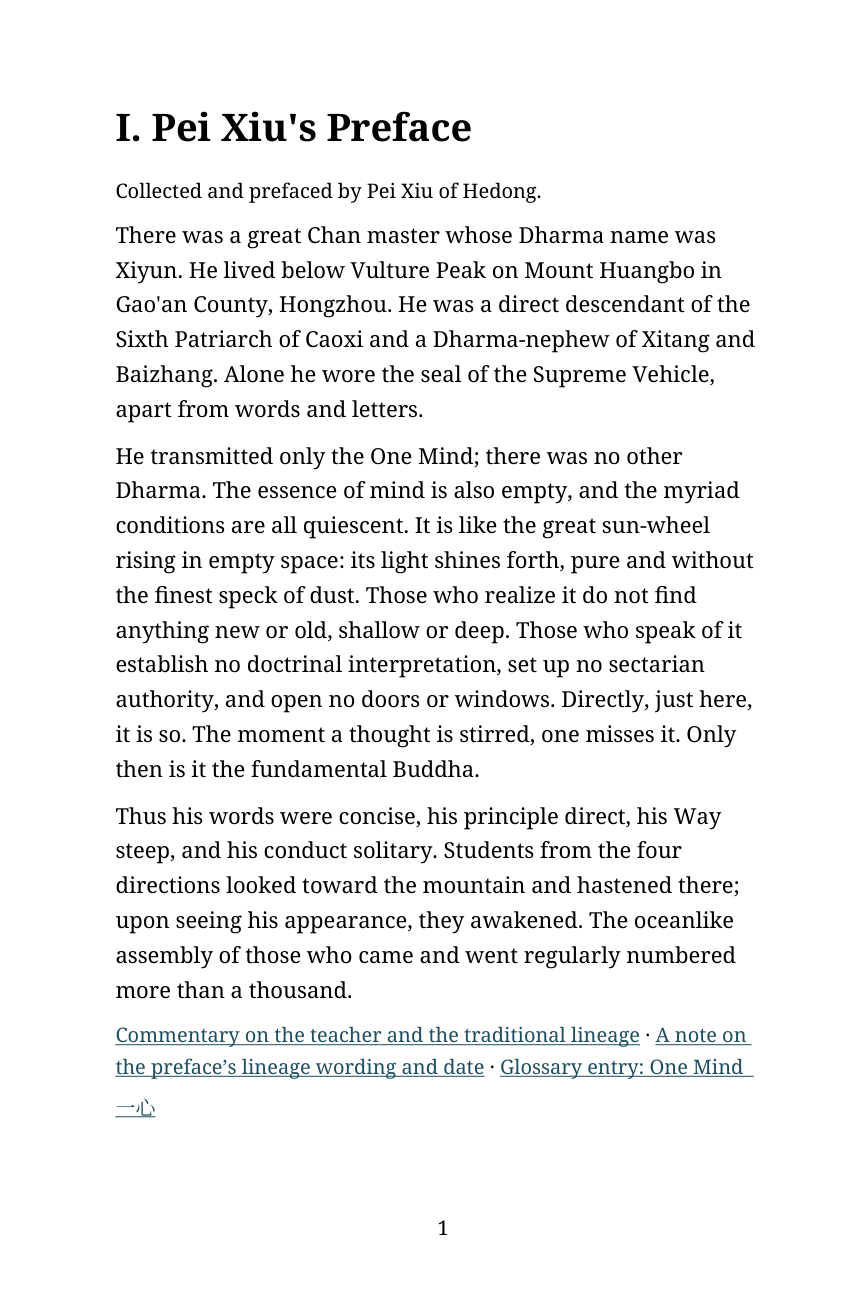
- Pei Xiu’s Preface and the two principal Huangbo collections.
- Twenty-eight appended materials with commentary.
- Glossary, source notes, and a guide for moving between passages and commentary.
Inside the book
Two sample pages from the current PDF. Click either image to read it at full size.
How this translation was prepared
The translation and commentary were developed under Soh Wei Yu’s Chinese-language review and editorial direction, with help from AI tools for drafting, comparison and checking. The book clearly marks the translation, commentary and quotations from other authors.
What has changed
The second edition presents a brand-new English translation undertaken afresh from the original Chinese texts. It replaces the earlier English translation while retaining the full substantive commentary and scripture passages, together with Chinese text and pronunciation guides. The contents and source notes have also been made easier to follow. Both main records and all 28 appended items were already included in the 2025 edition. The page references and ebook contents have been checked; the further reviews described above are still needed.
For sustained reading, use the PDF or EPUB. Use the Word edition when you need an editable copy. If your browser retains an older file, refresh the page and download again.


Comments
William Kong
It’s been many years since I’ve read Blofield’s translation of Transmission of Mind, so I have some questions:
a) How did you generate the new translation? Was it via the original Chinese text?
b) When you are going through the LLM’s translation, can you illustrate some quibbles you had with Blofeld’s rendition so we can can see what distinctions within the newer translation that you like. I think footnotes that illustrate the subtleties within key parts that you think were mistranslated would be useful
edit: if my intuition is correct, then I believe you are going to explicitly distinguish between One Mind (the mirror is not-empty but interpreted as either subtle self: self-existent/inherently existent, or reified as a substance aka an empty container)
b) No Mind, the mirror like mind has always been empty.
1h
Reply
Edited
Soh Wei Yu
John Blofeld's one is much less accurate and precise. Gemini's one is just accurate and precise to the letter. Hardly any changes needed from my side.
Blofeld:
This Dharma is Mind,beyond which there IS no Dharma; and this Mind is the Dharma, beyond which there IS no mind. Mind in itself is not mind, yet neither is it no-mind. To say that Mind is no-mind implies something existent.
Gemini:
This Dharma (Phenomenal World) is precisely Mind; outside of Mind, there is no Dharma (Phenomenal World). This Mind is precisely Dharma (Phenomenal World); outside of Dharma (Phenomenal World), there is no Mind. Mind itself is without mind; nor is there one who makes mind 'no-mind'. To use mind to make mind 'no-mind' – mind instead becomes existent.
John Blofeld:
To eliminate environmental phenomena, just
put an end to your conceptual thinking. When this ceases,
environmental phenomena are void; and when these are
void, thought ceases. But if you try to eliminate environ-
ment without first putting a stop to conceptual thought,
you will not succeed, but merely increase its power to dis-
turb you. Thus all things are naught but Mind — intangible
Mind; so what can you hope to attain? Those who are
students of Prajna^ hold that there is nothing tangible
whatever, so they cease thinking of the Three Vehicles.^
There is only the one reality, neither to be realized nor
attained. To say T am able to realize something’ or T am
able to attain something’ is to place yourself among the
arrogant. The men who flapped their garments and left
the meeting as mentioned in the Lotus Sutra were just such
people.^ Therefore the Buddha said: T truly obtained
nothing from Enlightenment.’ There is just a mysterious
tacit understanding and no more.
Gemini:
"Ordinary people all pursue realms [objects], giving rise to mind, and the mind then develops liking and aversion. If you wish for no realms, you must forget the mind. When the mind is forgotten, realms are empty; when realms are empty, the mind is extinguished. If you do not forget the mind, but merely try to eliminate realms, realms cannot be eliminated, only increasing confusion. Therefore, the myriad dharmas are Mind-only. Mind is also unattainable; what else is there to seek? People who study Prajñā see not a single dharma that can be obtained. They cut off intentions regarding the Three Vehicles. There is only the One Reality, which cannot be realized or obtained. Those who say 'I can realize, I can obtain' are all people of arrogant conceit [adhimāna]. Those who brushed off their robes and left the assembly in the Lotus Sūtra²⁴ were all such types. Therefore, the Buddha said: 'Regarding Bodhi, I have truly obtained nothing.' Silent accord is all.
--> Huang Po is saying Mind too is unobtainable, realizing No Mind (Mind being empty of substantial existence, anatman). But John Blofeld misunderstood and just treat it as a state of non-conceptuality, like realizing Mind and being nonconceptual which anyone at the I AM stage would say the same.
John Blofeld on the other hand, was a Vedantist in view, an Atma-vadin who misunderstood Huang Po's One Mind (which is empty -- Mind is empty of Mind) as Advaita's Brahman and Universal Consciousness, as he said:
"The Mahayanists accept the interpretation of ‘egolcssness*, holding that the
real ‘Self* is none other than that indescribable ‘non-entity*, the One
Mind; something far less of an ‘entity* than the Atman of the Brahmins.
Goomaraswamy, for example, interprets the famous precept ‘Take the
self as your only refuge* not by the Theravadin ‘Place no reliance upon
intermediaries*, but by ‘Take only the Self as your refuge*, the ‘Self*
meaning the same as the One Mind. If the Theravadins are right with
their ‘No ego and no Self*, what is it that reincarnates and finally enters
Nirvai^a? And why do th(^ take such pains to store up merit for future
lives? For if the temporarily adhering aggregates of personality are not
held together either by an ego-soul or by a Universal Self or the One
Mind, whatever enters Nirvana when those aggregates have finally dis-
persed can be of no interest to the man who devotes successive lives to
attaining that goal. It is also difficult to understand how Buddhism
could have swept like a flame across Asia if, at the time of its vast ex-
pansion, it had only the cold comfort of the present Theravadin inter-
pretation of anAtman to offer those in search of a religion by which to
live. Zen adepts, like their fellow MahSyanists, take anAtman to imply
‘no entity to be termed an ego, naught but the One Mind, which
comprises all things and gives diem their only reality.’
In fact in his earlier rendition, he titled it "I made several years ago, which was published under the
title of The Huang Po Doctrine of Universal Mind". Totally distorting Huang Po's teaching into a non-Buddhist doctrine of eternalism and universal consciousness.
22m
Reply
Soh Wei Yu
William Kong And not mentioning he tends to use Vedantic terms or substantialist terms like Absolute, etc, which has no bearing at all with the Chinese text.
I translated it entirely from Chinese.
The prompt I used is my general prompt:
Translation Prompt v2.2
See
https://www.awakeningtoreality.com/2024/12/the-text-prompt-to-translate-dharma-text.html