The Heart of Zen: Huangbo’s Teachings on Mind — Second Edition

By

Second edition · 3 November 2026 · Digital review edition

The Heart of Zen: Huangbo’s Teachings on Mind

A brand-new translation from the original Chinese, with commentary by Soh Wei Yu.

This revised edition brings together Pei Xiu’s Preface, the Essentials of the Transmission of Mind, the Wanling Record, and twenty-eight appended materials, with an introduction, commentary, glossary, source notes, and a reading guide.
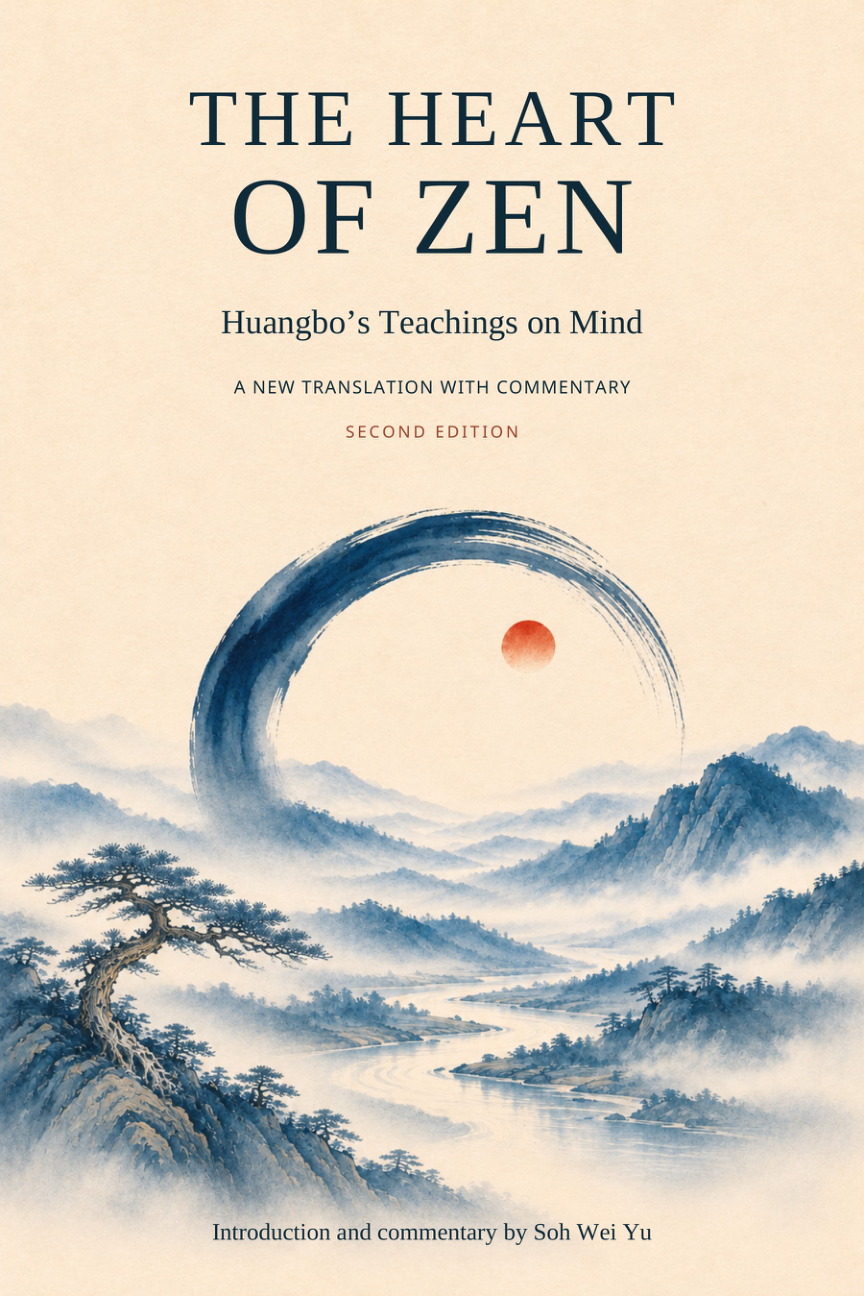
The Heart of Zen: Huangbo’s Teachings on Mind, second edition cover

Read and download

Download PDFDownload WordDownload EPUB

The current files are the HI017 digital review edition, revised 9 November 2026. The PDF contains 331 pages in a 6 × 9 inch format. Choose Word if you need an editable copy, or EPUB to adjust the text size in your ebook reader.

Edition status: This edition is free to read and study while final checks continue. The PDF, Word and ebook contain the same revised text. Further checks are still needed in Word, on ebook readers and for accessibility, along with independent specialist review and checks of sources and quotation use. It is not yet the final print or retail edition.

About this edition

Huangbo’s teachings repeatedly cut through the effort to grasp awakening as an object, an attainment, or a separate knower behind experience. This edition places a new English translation from the Chinese alongside commentary and notes explaining the sources. The translation is clearly separated from the commentary.

The introduction discusses luminous knowing, the direct realization of Mind, and the further examination of a seemingly independent subject or background behind appearances. The commentary connects difficult expressions and allusions with their immediate passages rather than asking readers to rely on isolated English phrases.

What is included

  • Introduction and orientation to the translation and commentary.
  • Pei Xiu’s Preface and the two principal Huangbo collections.
  • Twenty-eight appended materials with commentary.
  • Glossary, source notes, and a guide for moving between passages and commentary.

Inside the book

Two sample pages from the current PDF. Click either image to read it at full size.
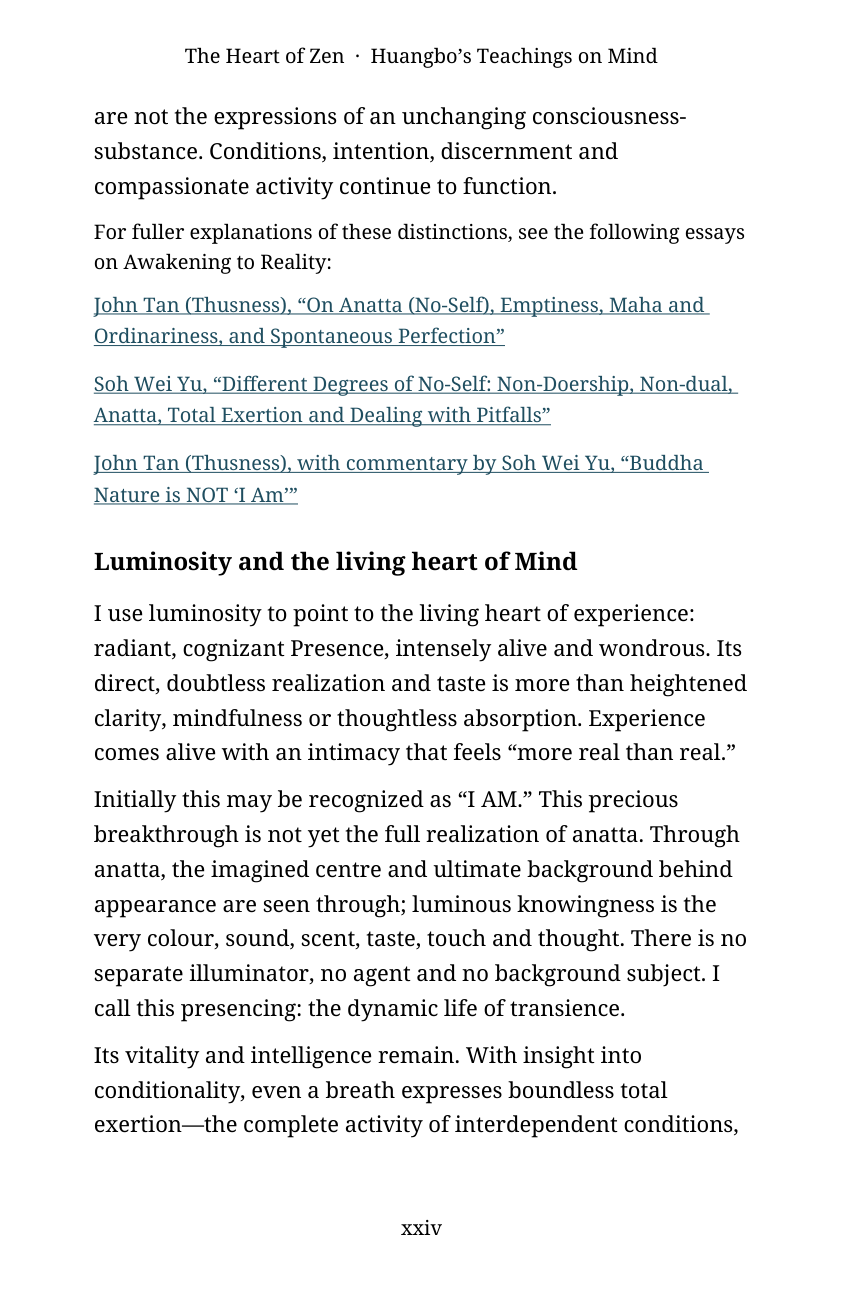
Introduction, printed page xxiv: luminosity and the living heart of Mind
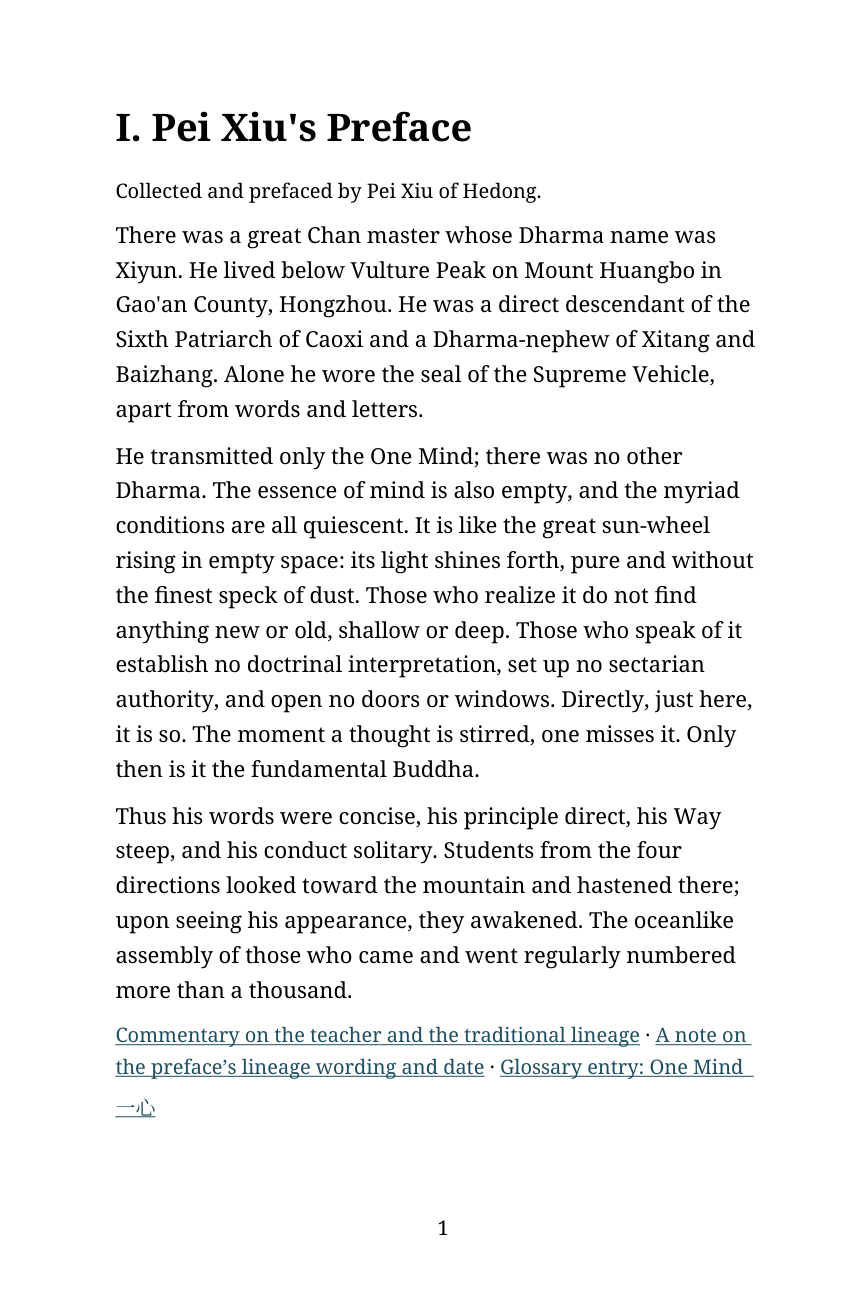
Pei Xiu’s Preface, printed page 1

How this translation was prepared

The translation and commentary were developed under Soh Wei Yu’s Chinese-language review and editorial direction, with help from AI tools for drafting, comparison and checking. The book clearly marks the translation, commentary and quotations from other authors.

What has changed

The second edition presents a brand-new English translation undertaken afresh from the original Chinese texts. It replaces the earlier English translation while retaining the full substantive commentary and scripture passages, together with Chinese text and pronunciation guides. The contents and source notes have also been made easier to follow. Both main records and all 28 appended items were already included in the 2025 edition. The page references and ebook contents have been checked; the further reviews described above are still needed.

For sustained reading, use the PDF or EPUB. Use the Word edition when you need an editable copy. If your browser retains an older file, refresh the page and download again.

Zen is not JUST ceasing concepts

By

 Mr C:

Huangpo said all that is needed is to cease attachment and stop ruminationSkylinens Snoovatar

12:56 AM


Soh replied: 

huang po also said "It is the sudden realization that there is neither Buddha nor sentient beings, neither subject nor object.", "A perception, sudden as blinking, that subject and object are one, will lead to a deeply mysterious wordless understanding; and by this understanding will you awake to the truth of Zen.", and so on

At the time of his enlightenment, Zen Master Huangpo said, "When I hear the sound of the bell ringing, there is no bell, and also no I, only ringing-sound."

many other zen masters said likewise, such as, (excerpts from https://www.awakeningtoreality.com/2022/10/some-zen-masters-quotations-on-anatman.html )

Zen master Munan said, “There is nothing to Buddhism—just see directly, hear directly. When seeing directly, there is no seer; when hearing directly, there is no hearer.”

>Shidō Munan (至道無難, 1602-1676) was an early Tokugawa Zen master mostly active in Edo. He was the teacher of Shōju Rōjin, who is in turn considered the main teacher of Hakuin Ekaku. He is best known for the phrase that one must "die while alive," made famous by D.T. Suzuki.


….

Another Zen Master said,

'You get up in the morning, dress, wash your face, and so on; you call these miscellaneous thoughts, but all that is necessary is that there be no perceiver or perceived when you perceive—no hearer or heard when you hear, no thinker or thought when you think. Buddhism is very easy and very economical; it spares effort, but you yourself waste energy and make your own hardships.'


(Foyan Qingyuan, in Instant Zen, p 70)

so a key insight is the insight into anatman, no self, for zen enlightenment

zen is not simply a state of suspending mental concepts, it requires an awakening, a satori, a seeing into the nature of mind, empty of self and luminous

or said in another way,


"The process of eradicating avidyā (ignorance) is conceived… not as a mere stopping of thought, but as the active realization of the opposite of what ignorance misconceives. Avidyā is not a mere absence of knowledge, but a specific misconception, and it must be removed by realization of its opposite. In this vein, Tsongkhapa says that one cannot get rid of the misconception of 'inherent existence' merely by stopping conceptuality any more than one can get rid of the idea that there is a demon in a darkened cave merely by trying not to think about it. Just as one must hold a lamp and see that there is no demon there, so the illumination of wisdom is needed to clear away the darkness of ignorance." - Napper, Elizabeth, 2003, p. 103"


The AtR Dharma Library

Must Reads

New here? Begin with Seven Stages, then On Anatta. Explore the full collection below.

View full list on page →

New in the AtR library

Latest posts

Up to 20 recent articles, newest publication first.

Browse more posts below.

Browse more posts →

AtR Library

Browse books, articles, recordings and ways to follow AtR.

Start Here →Recommended readings and the free AtR guides John Tan’s Website ↗
Free Books
    View section on page →
    Featured Articles
      View section on page →
      Audio & Video
        View section on page →
        Further Reading
          View section on page →
          Follow Awakening to Reality
            View section on page →
            Full library on page

            Search AtR

            Examples: anatta · I AM · emptiness · dependent origination · Zen · Mahamudra · Dzogchen

            Try Google for broader results ↗

            Google searches this site in a new tab.