Explanation of the Record of Chan Master Hongzhi

By
Awakening to Reality · English house edition

Explanation of the Record of Chan Master Hongzhi

A teaching by Zen Master Hong Wen Liang.Source: Original published article · Singapore and Malaysia
English house edition · Chinese original available below

Radiance of Mind and the Six Faculties

Explanation of the Record of Chan Master Hongzhi1: “Therefore it is said, the myriad dharmas are the radiance of mind; all conditions2 are clarified only by their nature3.” If you can distinguish that this is a visual appearance, that is a sound, and that this is thought in the intangible domain of mind, all of this is due to that “nature,” which enables you to discern clearly—merely clarification by nature, not some real entity. Thus, in such a moment, naturally you need not speak of not being entangled by conditions—how could you be entangled by conditions? Who would ensnare you? What could be ensnared? The whole of it is the total field of the dharma-realm already complete as it is—this is the meaning. This is the “truly great person of wisdom.” This alone is genuine great wisdom4—“perfect and equal awakening”; this is the Buddha’s seeing and knowing.

Your six sense faculties are originally just like this; the utmost Way manifests there. This is called “thus can self-know.” It is simple: you are originally like this. As long as you do not stain it, as long as you do not add in the delusive thought “this is mine,” you will then know your own genuine functioning. That movement is not some “you” who uses5; that movement—moving—is best just called “moving.” “Thus self-illumined” does not mean some self deliberately knowing itself; it is because it is your own affair. Your teacher, your lama, even the Buddha cannot know exactly how your own ears and eyes, your six faculties, move. It is you who move—not the Buddha who moves. It is not someone else’s power that knows; even when you say “I know how I am thinking,” it is that very thinking of yours moving there. Therefore it is “self-illumined.” Only you are most clear about your own true situation. So long as you do not raise delusive thoughts, do not add “these are my ears moving, my eyes moving,” then—if your madness flares up, if you split your mind—you create subject and object; once there is subject and object, emotions are stirred and become emotional dusts. Originally the six sense-objects have no fault. How could the six dusts have any sin? Is this clear to everyone here?

Walking, standing, sitting, lying—daily life—doing business, being a doctor, a lawyer, a president, a warlord, a hooligan, a great villain—all is “borrowing the road to set the feet.” If your eyes, ears, nose, tongue, body, and mind were not functioning there, why would I speak of “pure and wondrous luminosity6”? In everyday life, of course, when you fight with someone that too is “borrowing the road to set the feet,” and when you do many charitable deeds as well. Are you not using your six faculties? If you want to strike someone, without your eyes to see the target, how could you strike? “Spirit’s pivot, wondrously responsive”—the six faculties move. Because you have realized that the six faculties themselves are pure and wondrously luminous, it is not that there is a “me” needed in order to move. Move like this—self-forgotten, without the least bad intention of “that is mine,” cleanly shed. To move like this is “the spirit’s pivot, wondrously responsive.” As long as delusive thoughts are not added in, still you must move—how could you not move? “Whatever is encountered is true”—whatever you do is just right.

“Not even a hair’s breadth, not even a speck of dust, is something from outside.” Clap! A sound like this, or drinking water—the mind and circumstances are one. Your whole dharma-body is moving there—is this an external thing? We have always taken it to be something external; therefore you fundamentally do not know the pure, wondrous luminosity. Not knowing the wondrous luminosity, you do not know the pure field either. That field is originally pure and wondrously luminous. When you look at me, when you listen to me, it is your pure, wondrous luminosity moving there. It is not that “I go drink a cup of tea,” or “I go look at you—you are over there, I go look.” Not like this. If you experience this deeply, you will be wholly and truly “self-illumined,” “self-clarified,” “wisdom.” Thus, when you realize this, you will “not have even a hair or a speck” that is external. Now when you hear the sound of a car outside, it is not that outside there is a sound-dust; your dharma-body moves right here. Your pure, wondrous luminous field does not move; whatever horns they honk has nothing to do with you. You certainly have this—your pure, wondrous luminous field—so that sound is precisely that field moving thus. Therefore it is said that not even the least bit or the least mote is something from outside; it is the transformations revealed in your own inch-square of mind. Once this is clarified, you make no division into you, me, and others; thus it is not that you yourself are living, nor that there is some self of yours that dies. It is the whole dharma-realm. Your birth is the dharma-realm’s birth, the appearance of birth; when dying, it is the power of the dharma-realm—as when autumn arrives, it takes on the aspect of autumn. It is not that summer dies and becomes autumn—no! In accord with conditions, it appears accordingly. All of it is your own manifestation; it is not “some external thing.” There is no problem here. If you only infer by speculation, you can only think it out this far. But when you constantly are “moment by moment unconfused,” it is not that you force yourself to be unconfused; your six faculties are originally moving in an unconfused state. What clouds it is that we suddenly raise a strange thought, erecting the frame “hey, I am listening,” and the constant light is dimmed. But it is not truly dimmed; it is just that a very self-referential cloud covers it. It has not moved away; it is “pure by nature from the beginning.” The hardest thing to realize personally is precisely that not a hair or a speck is “from outside.”

Beyond Words and Concepts

“Wondrously transcending the path of words”—by language, writing, thought, you may write and think for half a day, and none of it is it. It itself has this capacity; it itself wondrously surpasses. When we hear the sound of a frog, “ah—right, right,” yet in truth the real sound of the frog we have no way to reach: “the path of language is cut off; the domain of the mind’s activity ceases.” However you think it, it is not itself; however you say it, it is not itself. “Ah, so hot!”—is that “so hot” the heat itself? Then bring forth that heat—can you present it? “Wondrously transcending the path of words”—because through language and writing, through trained thought, we can express by language and script, yes? But language, writing, and discursive mind are false, illusory signs; they are not the real heat itself. The real is hot—or, how do you say it in Hakka? “ne”? You say “ne,” I say heat is “Ah-shui.” In the end is “Ah-shui” right or is “ne” right? The genuine heat itself does not care whether you call it “ne,” “Ah-shui,” or “hot”—it does not care. Because when we say “ne,” or “hot,” or “Ah-shui,” none of that is it. They are illusory and false. The real is only that very “Ah-shui” itself—by what thought, language, or writing could you truly reproduce it? There is no way. This is what is called the real. We cannot touch it, cannot grasp it, cannot conceive it. This is “wondrously transcending the path of words.” Who wondrously transcends the path of words? Clap!—this very “wondrously transcending the path of words.”

If you are constantly in this correct, original way—“the constant light right before you, moment by moment unconfused”—then of course you know that mountains, forests, grasses, and trees are all manifesting this affair. What you see and what you hear are your own dharma-body appearing in accord with conditions; thus, before your eyes there is radiance and earth-shaking movement. “The four great elements and the six faculties, inner and outer, are illusory”—the six faculties are not any real things. What are they in themselves? Unknown. Therefore the four great elements and the six faculties are thoroughly empty and quiescent7; inner and outer are illusory. Illusory yet empty and quiescent—things without any self-nature gathering together—inner and outer are like this. Then how is it that they appear so distinctly before you? How is this? What indeed is it? Here you must apply your heart to investigate—thus he, upon seeing the morning star, had such an event.

Dharma-nature is without form and without appearance—how could you recognize some dharma-nature as “yours” and “mine”? One cannot even speak of “the same,” for to say “the same” requires appearances to compare; “not the same” also requires appearances to compare. Since it is “non-abiding,” that is, it has no appearance—you cannot locate it; if there is an appearance you can locate it, “ah, there.” Location. “Non-abiding” means formless and without appearance: neither great nor small, neither sound nor smell—nothing at all—beyond the range of your cognition. Therefore non-abiding is signless; signless is non-abiding. Non-abiding is emptiness8. Emptiness is limitless capacity: whatever conditions are present, it becomes those conditions. What is the fundamental essence? Search yourself to death and even the Buddha would not know—because it belongs to the unknown. In educating people, we always teach people to know; thus modern education fails in this way. Genuine education should include “something not known.” Only when you know there is something not known is it true knowing.

Yet after hearing so much, in practice—when you stand up you say, “Huh, what was just said?” It sounded right while hearing it, but upon standing you cannot bring any strength to bear. Why? What you heard and thought were all matters within imagination, things at the level of conceptual understanding; without that event of “seeing the morning star,” all of it is but water and moon.

What is the best method of practice? So much doctrine and explanation—do not leave even a bit of it in your head. If you force yourself to remember, that is just remembering—it has no effect. The best method is: whatever you are doing, whatever you think, hear, feel—whenever any habit arises, whether an angry thought or greedy thought—immediately know whether there is an “I” moving there. Practice just this, and it is enough for your cultivation. You will certainly discover that the false “I” is moving there. Not only in bad things—also in good things; and even in what is neither good nor evil, still that “I” is moving. I cross my legs without noticing—and there is that “yo…” the “I” accomplishing so-and-so; that “I” is certainly there. This is because you have not thoroughly realized; that event of “seeing the morning star” has not occurred. Outside of this—outside what Buddhism, outside Chan—Buddhism’s generations of transmission certify nothing other than this; the rest are merely done at the level of scholarship and thought. When does this come? Just as I have said before: “A night’s rain of falling blossoms; the whole city is fragrant with flowing water.” “On Sumeru’s peak there is a rootless tree; without touching the spring wind, flowers bloom of themselves.” A tree without roots—why would its flowers open of themselves without spring? What is this? It is beyond thinking—at the moment you awaken. Upon seeing something—at such a moment—“ah!” Just that “ah”—“a night’s rain of falling blossoms”—there, it has come; whether you want fragrance or not, the “whole city is fragrant with flowing water.” Whether you want fragrance or not, you still get fragrance. If you strain to want fragrance, to want awakening—you will not get it. It is just like this. You cannot make it night; now it is night. What is “night”? Is there some “night” that comes from somewhere? It is the relation between earth and sun—I like to use a modern explanation people can grasp—when the relation changes, that is night. From where would some “night” fall down? Thus all the myriad phenomena of life and death are like this. But if you do not have your own fundamental nature, without the responsive function, then there would be no night—forever useless, nothing to do with you.

Nondual Knowing and the Question of Mind

Your field must certainly radiate light and shake the ground. How to radiate and shake the ground? In accord with conditions. Yet you do not dwell on conditions. Is this something produced by thinking? Something you arrive at by cultivating? Something gained by study? None of these. It is “of itself thus” from the outset. This “of itself thus” is not the “naturalness” of your views and understanding9—that is something you think. When you personally realize this natural thing, it is not through thought. It is originally just like this—that is the thought of essence. “That is very hot”—if you have not touched heat, it is merely so said.

Mountains and rivers, the sound of frogs—none of these are separate; there is no division between me and what I see, between me and what I hear—only then is it “reflecting without a dualistic stance toward conditions, knowing without touching things.” Is this not “knowing without touching things”? This precisely is it. You say this is inanimate—why then does it have knowing? It is only that you do not understand the knowing that knows without touching things, and thus you persist in thinking that such knowing is impossible.

You stubbornly assume that cognition must be a mental operation that goes out to cognize, and you take that as knowing; therefore you do not understand its meaning, nor the Buddha’s “both together pacified and extinguished.”10 “Both together pacified and extinguished” does not mean there is no sound, no appearance, no pain, no itch—not like that. Pain is very painful; comfort is very comfortable. But is there an experiencer and a thing experienced? The subject and object you suppose are not there. Yet it does not belong to the exchange of the subject and object you hypothesize—this is “both together pacified and extinguished.” The illumining and the one who illumines—both together are quenched. Do you understand? Because this “illumining” and “illumined” are notions you have set up, a concept arises called “there is an illuminer and an illumined,” “there is a hearer and that which can be heard.” Such “illuminer and illumined” are conceptual.

“To settle the matter” means to settle one’s own matter of birth and death. How to settle it? You must know what you yourself are. Why is “knowing what you are” called “apprehending Mind”? We would not take hair, nose, feet, and hands to be ourselves, right? Because we all know they will grow old, die, rot, be burned or buried and become water, become earth—return to earth. We all know these things are given to us for temporary use. Yet we still invariably suppose there is a soul—we call it mind. Is this soul really there or not? If it exists, where is it hidden? It has no appearance. Without an appearance, how do you know there is a soul? You cannot see it or touch it—yet you say it exists. Ordinary people think like this. So those who study the Buddha-dharma continually call this their soul, their mind—therefore there can be rebirth. Otherwise, what is it that is reborn? Does the body come back? We invariably assume “my mind is precisely my mind,” and so it can be good or bad, go to hell or to the heavens—always “my mind” changing up and down. Is there not, then? The Buddha-dharma speaks of rebirth—everyone takes it like this—of wholesome and unwholesome karma. And where do wholesome and unwholesome karma adhere? They adhere to what you take as “mine,” not something else—absolutely “mine.”

What is it like? Unknown. The Buddha tells us it is formless, colorless, without appearance, untouchable, unseen. Yet the Buddha speaks of rebirth—so it exists, how could it not? But look—the mistake lies here. What the Buddha truly said is that even your “soul” does not exist—not even your “soul.” And as for the functioning of our mind—do we not take that as “mind”? A rainbow in the sky—does it not both exist and not exist? The moon’s reflection on water—is it present? It is present—you cannot say it isn't. But when you take your “soul” as truly existing, you are taking the moon’s reflection on water as real—you try again and again to scoop it up. Only after repeatedly trying to scoop it up do you know you cannot. Therefore practice—study, reading scriptures, sitting in meditation1112, bowing to the Buddha, doing good—these are not useless. You must pass through this (body-and-mind shed) or else you will never give up the fixation.

Repeatedly try to scoop—where do you try? In daily life, at the gates of the six faculties. Carefully observe it; carefully make offerings to it. To “make offerings to the person of no-mind” is like this. This practice is difficult—difficult to the extreme—because we immediately forget.

At the very moment, it is already past; you are within conditions but not on conditions. A wooden horse neighs in the wind; a clay ox emerges from the sea—everywhere is just so. This is the person of no-mind. Leap out of your thought and conjecture.

Essence, Function, and Direct Accord

Without even stirring a thought, he points to this dharma-seat, representing that original position. Speaking in terms of essence and function, he uses “the portent has not yet arisen” to indicate it. Before it has begun to function, before its functioning is revealed, one must “borrow function to clarify position”13—borrow the sounds, feelings, appearances, thoughts, tactile sensations, fragrances, and so on which issue forth from it—borrow the various functions that appear, the kinds of virtues, merits, and uses that are displayed. “Ah! So there is the one”—from that position, that is, from the fundamental essence, we “borrow function to clarify position.” That is one side. The other is: “as soon as an influence shows, one must also borrow position to clarify function.” When there is an influence, there is already a shadow, a sound, a thought moving, an emotion moving, qi moving. When qi moves there is influence; there is some appearance—whatever it may be, a thought or qi—so long as there is something perceptible. “As soon as an influence shows,” when there is just a hint of a message, “one must also borrow position to clarify function”—this sound, this appearance, this thought, this feeling, this qi—how did it come? You must borrow the fundamental essence to explain it—“borrow position to clarify function.” Both are needed: one is “borrowing position to clarify function,” the other is “borrowing function to clarify position.”

Whether from color, sound, fragrance, taste, touch, and dharmas—“Ah!”—you suddenly penetrate to the source; or from the source you suddenly understand the function—the six sense-objects as well—altogether are marvelous function. None of this can be done by thinking, right? Hence we call it “one-thought accord.”14 In that very instant, without analysis, without any emotional veneration—none of that—one-thought accord. How is that moment described? “The junctures of before and after are cut off.” The before and the after are cut. What does it mean? It means there is no time. We assume there is time past in front and time after behind, and thus we feel time is flowing. When the junctures before and after are cut, time stops. But it is not that there is some “time” that can stop—how could time stop? The junctures of before and after are cut—time is cut. Time is what we imagine. Within our ideation there is a flow we call “time”; our mind strings it together.

Inference—comparison15—is the mind’s measure. It is a function of mind. What of the appearance itself? It is not something produced by mind. How would eyes present anything if there were no thing? Without something there, the eyes cannot present. The operation of eyes and things is together—this is the movement of the dharma-realm. It is not that your mind sees things coming and going, up and down—not like that. It is the functioning of the eyes’ own dharma-nature, the truly natural inherent power moving together with the outer circumstance—“mind and circumstance are one”—moving as it moves, moving as it truly moves. In moving, do not add comparison. Comparison is the mind’s analysis. To compare “this with the previous two,” you can then speak of this movement, of coming and going. But at the very moment the appearance itself manifests—at that moment—how could there be comparing with before and after? To compare with before, you must remember the prior appearance.

To remember is the mind moving. Without memory, how would you know movement? But the eyes—and the ears—when there is something, it appears; when there is not, it vanishes. Without this “comparison,” without that comparing faculty. Comparison means setting two things side by side. But the earlier has already passed—once a sound has passed, it is past. When you hear a later sound, by comparing you then say “this one sounds better, the former did not.” For the earlier you rely on imagination—on the power of mind. Delusive thought—what we call the discriminating power of mind—is added in so you can compare: pleasant or not, loud or soft. In that very instant, what “large or small” is there? None. This is my slight clarification of “borrowing function to clarify position” and “borrowing position to clarify function”—not using the head to contrive; it is originally like this. We simply had not noticed.

Conditions and the First Thought

They say, “Bring me the daytime.” Impossible! “When the wind blows, the grass bends; when water arrives, the channel is formed.”16 When the earth and sun revolve to align with the equator, daytime naturally appears—I cannot hand it to you. When conditions mature, it is naturally thus. Chan Master Hongzhi’s reply—“the wind bends the grass; water arrives and the channel forms”—is not evasion; it truly is like this. If your conditions have not come together, then they have not; yet you hope to know the Chan meaning transmitted by the Buddhas generation to generation—there is nothing I myself could say.

Because of habit, the thought arises—and immediately “I see, I hear.” Whatever thought arises, it is that “I” presiding. The “I’s” opinion inevitably enters in. At the “first-thought juncture,”17 your “wondrous” cannot arise. “Wondrously surpassing the first-thought juncture”—that “wondrous” does not emerge. You understand in theory that the “I” is wrong—that it is an imagined “I.” You understand this. But in reality, in every lift of the hand and step of the foot, there is that “I” investigating and watching—that one taking the lead. The “wondrous” does not arise—this is the very point. Therefore “one must further turn the body along another path” right here. When “essence” can reveal “function,” do not let the dualistic “I do something, I see something”—this thought—be added. The ears, fundamentally without this thought, are hearing; the eyes, without the thought “I see,” are seeing. They themselves are originally just like this. But our fault is that we continually have the extra thought “I am seeing, I am hearing” spring up beforehand.

Therefore, at the “first-thought juncture,” if you can illumine that faint sign and its function—once illumined, it is originally like that; essence and function move thus—do not cut in line with that added thought.

Notes

Notes identify source expressions and terminology; the English teaching above is reproduced without editorial rewriting.

  1. Hongzhi and silent illumination. Hongzhi (宏智禪師, usually identified as Hongzhi Zhengjue, 宏智正覺) is the Chan master named in the title. His teachings are associated with silent illumination (默照). The phrase “silent illumination” is not itself present in the supplied Chinese excerpt; the present text is Master Hong Wen Liang’s explanation. ↩
  2. Dependent origination and conditions. The opening Chinese quotation reads “萬法是心光,諸緣唯性曉.” Here 諸緣 means “all conditions.” Dependent origination is 缘起 (traditional 緣起), not “dependent existence”; the exact compound 緣起 is not stated in this passage. Later “in accord with conditions” corresponds to 隨緣 and 緣到了. These expressions do not license treating conditions or relations as independently existing things. ↩
  3. Nature and Buddha-nature. The opening has 性 (“nature”); later wording includes 法性 (“dharma-nature”) and 本性 (“fundamental nature”). Buddha-nature is 佛性, a related but distinct technical expression that does not occur literally in this excerpt. The rendering “nature” is retained as printed; the passage explicitly warns against making it “some real entity” (不是有實體). ↩
  4. Wisdom / prajna. The Chinese here says 大智慧 (“great wisdom”); elsewhere it uses 慧. Prajna (Sanskrit prajñā; Chinese 般若) is the conventional term for liberating wisdom, but the exact word 般若 does not appear here. The English words “great wisdom” remain unchanged rather than being replaced with an unsourced technical term. ↩
  5. Agent and doer. The Chinese reads “那個動,不是有一個你在用”; another passage says “並不是有一個我才能動.” Agent is glossed in this project as 主宰者, and doer as 造作者; neither exact Chinese technical noun appears in the excerpt. The emphasis is on not inserting an independently directing “I” behind the functioning of the six faculties. ↩
  6. Pure and wondrous luminosity. “Pure and wondrous luminosity” refers to 清淨妙明. The Chinese continues with 六根 (“six sense faculties”), 靈機妙運 (“the spirit’s pivot, wondrously responsive”), and 觸事皆真 (“whatever is encountered is true”). These are source phrases, not names for a separate observing entity. ↩
  7. Empty and quiescent. The Chinese says “四大六根,徹底空寂,內外虛幻,” with 空寂 (“empty and quiescent”) and 虛幻 (“illusory”). The nearby “沒有自性的東西” means things lacking own-nature; the negative is directed at intrinsic essence, not at the vivid occurrence of seeing and hearing. ↩
  8. Emptiness and non-abiding. The linked Chinese statements are “無住就是無相,無相就是無住。無住就是空。空就是無限的能力.” The word 空 is “emptiness,” alongside 無住 (“non-abiding”) and 無相 (“signlessness / without marks”). “Limitless capacity” is the speaker’s own wording; it does not establish emptiness as a separate substance or container. ↩
  9. View. The Chinese reads: 這個“自爾”不是你知見上的自然這樣。 “of itself thus” (自爾) is distinguished from a conceptual view (知見; simplified 知见) of naturalness. “View” here is not 見地/见地. The printed English “views and understanding” is preserved. ↩
  10. Illuminating and illuminated. “Both together pacified and extinguished” renders 二俱寂滅. The Chinese explains that “照與照者” (illuminating and the illuminator) and “能受所受” (experiencer and experienced) are conceptually posited pairs. Pain and sensation are explicitly not denied. ↩
  11. Seated meditation / zazen. The Chinese says 打坐 (“sitting in meditation” / “seated meditation”). Zazen (坐禪, Japanese 坐禅) is a familiar Zen term for seated meditation, but 坐禪 is not the literal phrase in this Chinese source. The published English is kept without substitution. ↩
  12. Samadhi. Samadhi (三昧 / 三摩地) denotes meditative collectedness or concentration, not simply the posture of sitting. Neither 三昧 nor 三摩地 occurs in the Chinese excerpt, which actually says 打坐. This note avoids adding “samadhi” to the quoted teaching. ↩
  13. Position, function, and the Chinese variants. The key source pairing is “借功明位” (“borrow function to clarify position”) and “借位明功” (“borrow position to clarify function”). The transmitted Chinese has local variants: “還須借位名功” (名 rather than 明), then “還須借功明位” even as the reciprocal explanation points to 借位明功. The supplied English is preserved; the variant is disclosed here rather than silently harmonized. ↩
  14. One-thought accord. “One-thought accord” corresponds to 一念相應. “The junctures of before and after are cut off” corresponds to 前後際斷. The teacher is describing an immediate mode of recognition, without comparison of earlier and later appearances. ↩
  15. Comparison. “Inference—comparison” points to 比量, the comparative or inferential measure, which the Chinese contrasts with the manifestation of the appearance itself (相本身). The distinction is preserved in the source English. ↩
  16. Wind and water. The Chinese is “風吹草偃,水到渠成”: grass bends with the wind, and a channel forms when water comes. The example is applied to the ripening of conditions (緣到了), rather than a separate entity called “daytime” that can be handed over. ↩
  17. First-thought juncture. The relevant Chinese expressions are 初念際 and 妙超初念際時. Later “do not cut in line” follows the Chinese “你不要插隊進去,” stressing the superadded “I see, I hear” thought rather than suppressing seeing or hearing. ↩

Original Chinese

Chinese original: 宏智禪師語錄講解

Show the complete Chinese original

【所以道,萬法是心光,諸緣唯性曉。】

你能分出這是色相,這是聲音,這是摸不到的精神領域的思想,這個都是那個「性」的關係,能夠讓你分別得清楚,曉,性曉而已啊。不是有實體。所以,這樣的時侯,你自然不要說不要被諸緣籠絡,你怎樣會被諸緣籠絡呢?誰籠絡了你?哪個被籠絡了?整個都是法界一切現成,就是講這個意思。這個就是“真正大智慧人”。這個才是真正大智慧啊。“等正覺”,佛的知見就是這個。

你六根本來就是那個樣子,至道在那裏顯現,這個叫著“能恁麼自知”,所以,簡單嘛,你本來就是這個樣子。你只要不把它染汙掉,將“這個是我的”的妄想加進去,才知道自己真實的那個動用。那個動,不是有一個你在用,那個動,moving, 動就最好。“恁麼自了”,這個不是自己很清楚知道自己,因為自己的事呀。你的上師、你的喇嘛或者佛也沒有辦法知你的那個耳朵眼睛六根是怎麼動。是你自己在 動,不是佛動呀。不是那個誰的能力去知道、就是我知道怎麼想也是你那個想在那裏動呀。所以就“自了”。自己真實的情況只有自己最清楚。只要不起妄想,不加 這個是我的耳朵在動,我的眼睛在動,這樣,你的神經病一起的話,精神分裂的話,就有能所,有了能所就情動了,變成情塵。本來六塵沒有罪過,六塵哪有罪過? 到這裏大家清楚了嗎?

行住坐臥,日常生活,做生意,當醫生,律師,大總統,做軍閥,做流氓,做大壞蛋,總是“借路著腳”。不顯現出來,你 的眼耳鼻舌身意在那裏,我說“清淨妙明”干嘛?在日常生活裏頭,當然,跟人家打架是“借路著腳”,做很多慈善事業也是。你還不是用你的六根呀。你要打一個 人,你沒有眼睛看對象,怎麼打?“靈機妙運”,那六根動,因為你證到六根本身它是清淨妙明,並不是有一個我才能動。這樣去動,忘我,沒有一點“那是我的” 的那個壞意念,脫略干淨。這樣動,就是“靈機妙運”。只要妄想不加進去,還是要動,怎麼不動呢?“觸事皆真”,做什麼事都是恰到好處。

“更無一毫一塵,是外來物爾”。啪!這樣的聲音,喝水,心境一如,整個你的法身在那裏動,這個是外物嗎?我們一直以 為這是外物,所以呢,你根本不曉得清淨妙明。妙明不知道,清淨田地也不知道。這個田地本來是清淨妙明。你看我,你聽我,是你清淨妙明在那裏動,並不是我去 喝一杯荼,或者我去看你,你在那裏,我去看。不是這樣。這個你體會得深,就完全真正“自了”,“自明”,“慧”。所以,你證到這個的時侯,你就“更無一毫 一塵”。現在你聽到外面汽車聲,不是外面有聲塵,你的法身這裏動,你的清淨妙明田地不動,它怎麼按喇叭都跟你不相干。你一定有這個,你的清淨妙明田地,那 個聲音就是你的清淨妙明田地這樣動。所以,叫著一點一毫一塵,通通不是外來的,是你自己方寸上所顯現的變化。這裏弄清楚了,這樣你就沒有分你我他,所以, 不是你自己在活到,自已有一個什麼自己死掉。不是。整個的一個法界的,你生是法界生,顯現生的樣子,死的時候是法界的力量,好象到了秋天,變成秋天的樣 子。不是夏天死掉變成秋天,不是!隨緣隨現!通通是你的顯現,不是“外來物爾”。這裏沒有問題了啊。用推想的只能這麼想,但是當你時常“念念不昧”,不是 你硬要不昧,你的六根本來就是不昧的情況下在動,疑是我們忽然起一個莫名其妙的想法是,“哎,我在聽”的那個架去了,常光就暗掉了。但不是暗掉,給你那個 很自我的雲遮住了。它沒有動掉,“清淨本然”。這個最難自己親證到,沒有一毫一塵是“外來物爾”。

“妙超語路”,用語言,文字,思想,寫了,想了半天,就通通不是它。它本身就有這個本事。它本身妙超啊。那麼我們本 身聽到青蛙聲,啊,對對對。但是,實際上呢,那個真實的青蛙聲,我們都沒有辦法,“言語道斷,心行處滅”。怎麼想都不是它本身,怎麼說都不是它。“啊,好 燙!”,好燙就是那個燙嗎?那你把那個燙表現出來,能夠表現嗎?“妙超語路”,因為言語文字,有了思想訓練,才能形諸於語言文字,對不對?言語文字跟心思 都是假的幻的代號,不是真正的熱本身,真實是hot,或,客家話怎麼講?ne,你講ne,我說熱是阿水,到底阿水對還是ne對?那真正的那個熱才不管你是ne還是阿水,hot,都不管。因為我們講ne,hot.或者阿水都不是它嘛。因為它是幻的、假的。真實只有阿水那個本身,能夠用什麼思想,言語,文字把那個真正重現嗎?沒有辦法。這個叫作真實。我們根本摸不到,碰不到,想不到。這個就是“妙超語路”。誰“妙超語路”?“啪!”這個“妙超語路”。

你時常都在這個正確、本來的那個樣子,“常光現前,念念不昧”,那當然知道山林草木,通通在發揚這個事呀。看的,聽 的,都是你自己的法身隨緣現,所以,在你的面前放光動地。“四大六根,內外虛幻”,六根沒有一個真正的東西。它本身是什麼東西,不知道。所以,四大六根, 徹底空寂,內外虛幻。虛幻而且空寂,沒有自性的東西湊攏來,內外都是這樣,怎麼這樣清清楚楚地現前昵?怎麼搞的,復是何物?在這個地方用心參,所以他一見 明星,有那麼一回事。

法性是無形無相,你怎麼認什麼法性分成你的,我的法性?連一樣的都不講,一樣的一定有相才能比才能講一樣呀。不一樣也要相來比才能講呀。既然它“無住”,就是它沒有相,你沒有辦法locate it;有了相你就能、就可以“啊”locate it。有location。 “無住”就是表示無形無相,無大無小,無聲無臭,什麼東西都沒有,不在你的認知範圍裏頭。所以無住就是無相,無相就是無住。無住就是空。空就是無限的能 力。緣什麼樣它就變成那個緣。本體是什麼?找死了佛也不知道。因為它是屬於不知的。我們教育人一定教人知,所以現代教育失敗是這樣。應該的真正的教育是有 所不知,你知道有所不知才是真知。

但是,你聽了那麼多,實際上,一站起來就“呵,剛才是講什麼?”,聽起來頻頻說對,站起來時就好象用不上力,為什麼?你那些聽的,想的,都是想像裏頭的事,知解上的東西,沒有一見明星那個事發生,便通通是水月。

修行最好的方法是什麼?這麼多的理論,說明,一點都不留在腦子裏,你硬記得,那是記得,沒有作用。所以,最好的修行方法是,無論做什麼事,或想到的,聽到的,感覺的,或者是哪個習氣,生氣的念也好,貪嗔的念也好,你馬上知道有沒有“我”在那裏動。你練習這個就夠你修行了。一定會發覺有那個假我在那裏動。不只壞事,好事也是啊。不屬於善,不屬於惡,也是有那個“我”在動。我蹺二郎腿呀,不知不覺有“喲......”我 在這樣做到的那個“我”在,一定在。那是因為你沒有徹證的關係。一見明星這個事沒有。這個跟其他的、連佛教的,禪宗之外,佛遞代相傳是證明這個以外,其他 都是在學問上、思想上這麼做。這個時侯來?就是我講過的,“一夜落花雨,滿城流水香”。“須彌頂上無根樹,不犯春風花自開”。沒有根的樹,不到春天為什麼 花自開呢?這個是什麼?非思量,你開悟的時侯。一見到什麼的時侯!“啊”的那麼一下,“一夜落花雨”,哎,下了,你不要很香,卻“滿城流水香”了。不要香 也得香啊。你拼命想香,想開悟,沒有呀。就是這樣。你不要它晚上,現在晚上了。晚上是什麼東西?有一個晚上嗎?地球跟太陽之間的關係,我喜歡用現代化人能 理解的,關係變了,就是晚上。哪有一個晚上從哪裏掉下來?所以,一切生死萬象都是這樣。但是,你沒有你的本性,沒有反應象那個晚上就沒有晚上。就永遠沒有 用,是跟你毫不相干的事。 ~~~~摘自『宏智禪師語錄』洪老師講解於星馬

你的田地一定要放光動地。怎麼放光動地?隨緣。但是,你不住在緣上。這個是思量來的嗎?你修行來嗎?你研究來的嗎? 都不是。本來就“自爾”。這個“自爾”不是你知見上的自然這樣。那是你用想的。當你這個自然東西親證到了,不是用思想。這個本來就這樣,那是體的思想。 “那個很熱”,你沒有碰到熱,就這樣。

山川,青蛙聲,通通是沒有分開的,我跟我所看到的,我跟我聽到的,沒有分開來,那個才叫作“不對緣而照,不觸事而知”,這個是不是不觸事而知?這個正是。你說這個是無生物,為什麼它有知。你就是不懂不觸事而知的知,就一直認為這個不可能是不觸事而知的知。

你死認為知覺一定要有一個精神作用,去認知的知,你把它當作知,所以你不懂它的意思,也不懂得佛的“二俱寂滅”。“二俱寂滅”不是沒有聲音,沒有色相,也沒有痛沒有痒.不是這樣。痛很痛,舒服很舒服呀.但是呢,有沒有能受所受?你假設的能所沒有。但是,它不屬於你假設的能所在交換,這就是“二俱寂滅”。照與照者,二俱寂滅。這樣懂嗎?因為,這個照與照者,是你立了一個念頭,起來一個概念,叫作有照的,有被照的,有能聽的,有能被聽到的,這樣就是概念上的照與照者。照與照者是概念。

“了事’就是了自己的生死事。怎麼樣了事?一定要知道自己是什麼東西。為什麼要把知道自己是什麼東西叫明心?我們不會把頭髮、鼻子、腳和手當作自己,對不對?因為大家知道這些會老,死掉會爛,燒掉埋掉會變水,變土,歸土嘛。大家知道這個東西是臨時給我們用。但是,我們總認為有靈魂在,這個靈魂,我們講心。這個靈魂到底是真的有還是假的?有的話,它藏在哪裏?沒有相。沒有相,你怎麼知道有靈魂?看不見,摸不到,但是有,一般人這樣想.所以學佛的人,一直把這個東西說是我的靈魂,我的心,所以才能輪迴嘛。否則,你在輪迴什麼?肉體回來了沒有?我們總認為我的心就是我的心,所以它會好會壞,到地獄去,到天界去,都是我的心變來變去,上下,總認為有我的心,難道不是嗎?佛法說輪迴,大家都認為這樣,善業,惡業。那善業,惡業依附在哪裏?依附在你認為是我的,不是別的,絕對是我的。

什麼樣子?不知道。反正佛告訴我們是無形,無色、無相,摸不到,看不到。但是佛講是輪迴呀,所以有呀,為什麼沒有?你看看,差就差在這裏.佛真正講的話,靈魂都沒有,你的靈魂都沒有。那我們的心的作用不是把它當作心嗎?天上彩虹不是沒有嗎?有 啊。水上的月影有啊。月影有就有,不能說沒有啊。你認為你真的有靈魂,就是把水上的月影當作是真的,你再三撈攏始應知。再三再三想把月影撈起來.再三撈攏 之後你才知道你撈不起來。所以,修行、讀書、讀經、打坐、禮佛,做好事,不是沒有用。你非得經過這樣(身心脫落),你不死心。

再三撈攏。在哪裏撈攏?日常生活裏,六根門頭,你仔細關照它,仔細供養它。供養無心道人,是這個樣子。這個修行才難呀。難的要命。因為我們馬上忘掉。

當下即過,在緣而不在緣。木馬嘶風,泥牛出海,處處都是。這是無心道人。跳出你的思想推想。

連思想都沒有動,他指這個法座,代表那個本位。體用的話,他用這個“朕兆未興”表示。還沒有啟用,還沒有顯出它的用以前,一定要“借功明位”,借它發出來的這個聲音,感覺,色相,思想,觸覺香味等等,借它顯示出來的各種functions,顯示出來的各種功德,merits,功用。啊,原來是有一個,從那個位,就是本體來“借功明位”。這是第一個。另外一個呢?“影響才露,還須借位名功”。一個是要想知道位置,本體,所以借這個用來講,啊,從這個本體出來。還有一個呢?“影響才露”,有影子了,有聲音了,有思想動了,有感情動了,有氣動了,氣動了就影響,有一個相,不管是什麼,思想也可以,氣也可以,反正有個東西讓能夠察覺出來。“影響才露”,剛剛有消息出來,“還須借功明位”,這個聲音,這個色相,這個思想,這個感覺,這個氣,怎麼來的?你要借這個本體來說明它,“借位明功”。兩個都需要,一個是“借位明功’,一個是“借功明位”。

它從這個色聲香味觸法“啊!”忽然徹到這個本源也好,從本源一下子明白了這個功,色聲香味觸法也好,通通都是妙用。這些都是不能用想的,對不對?所以我們叫著一念相應。當下都是那麼一刻,沒有思考,沒有什麼情緒上的崇拜,都沒有,一念相應。他怎麼形容這個時候的情況?“前後際斷”。前跟後都斷掉。怎麼講前後際斷?前後際斷就是沒有時間了嘛。我們認為有時間過去,前面有時間,後面有時間,才覺得有時間在流動。前後際斷就是時間停掉了。時間停掉不是有一個時間,時間怎麼能停掉呢?前後際,前際後際斷。就是時間斷掉。時間是我們想像出來的。我們的想念裏頭有時間的流動,那個流動我們叫著時間。其實這個是我們的心把它連起來的。

比量,相比的那個量是心。心的作用。相本身呢?不是心現出來,眼睛怎麼現呢?沒 有東西它就現不出來。眼睛跟東西的作用是一起一起,是法界的動。不是你的心,你的心看到東西來去,上下,不是的。都是眼睛的法性的那個用,真正自然本有的 力量,跟外界“心境一如”,一起動,動的樣子如實的動,動的時候不加進這個比量,比量就是心的分析。前面的兩個相比起來,你才能夠講出這個動,來了去,那 個相本身性現的那個moment,moment,那一刻當下當下,哪有跟前面後面比?要跟前面比一定要記到前面的那個相。

記,心動。沒有記你怎麼知道動?但是,眼睛呢?耳朵呢?有 就顯,沒有就消失,沒有這個比量的一個,比量是相比較;相比較一定要兩個東西拿來比,但是前面已經過去了,聲音一過去就過去,你一聽後面的聲音,就一比就 說現在比較好聽,剛才不好聽.那前面的你憑想像呀。憑心的力量,妄想,我們叫著心的分別力量加進去,你才能比呀,好聽不好聽,大聲,小聲。當下那一刻有什 麼大小?沒有。這是我把借功明位,借位明功這些稍微清楚一點講,不是用頭腦,本來是這樣。我們沒有注意到就是。

說“將白天拿給我”。不行呀,“風吹草偃,水到渠成’,等地球跟太陽相繞到和赤道一樣,自然就出現白天啦,不是我可 以拿給你的。緣到了,自然就這樣啦。宏智禪師“風吹草偃,水到渠成”的回答,不是躲開問題,真的是這個樣子。你緣不到,就是緣不湊合,你卻希望知道佛的遞 代相傳的禪意是什麼,我自己都沒有辦法講。

因為習慣,念頭來了,馬上“我看到,我聽到”,什麼念頭來了,都是那個“我’在主持。“我”的意見一定進來,這個“初念際”的時侯,你妙不起來。“妙超初念際時”,那個“妙”不起來,就呵...理 論上知道,那個“我”是不對,那個是“我”想像的,你知道知道這個,但是,實際上呢,每一舉手,一投足,都有那個“我”在探討,在看。那個在帶頭,那 “妙”不起來,就在這個地方。所以“更須轉身一路”就在這裏。“體”能夠顯“用”的時侯,不要讓那個二元的“我做什麼,我看什麼”,這樣是念頭,不要加進 去。耳朵根本沒有這個念都在聽,眼睛不要有這個“我看”的念頭,它也在看。它本身本來就這樣,但是,我們的毛病就是一直有一個“我在看”,有一個“我在 聽”的那個多餘的念頭先跑出來。所以,“初念際”的時侯,你能夠將那個朕兆照用,一照,它本來是那個樣子,體用是那樣動,你不要插隊進去。

—— Extracted from “Explanation of the Record of Chan Master Hongzhi,” taught by Teacher Hong in Singapore and Malaysia.
Second Editions Now Available: Bodhidharma, Huangbo and the Chinese AtR Practice Guide

By

Second Editions Now Available: Bodhidharma, Huangbo and the Chinese AtR Practice Guide

Brand-new retranslations of Bodhidharma and Huangbo from the original Chinese, alongside revised Simplified and Traditional Chinese editions of the AtR Practice Guide.

Hi everyone,

The second editions of The High-Fidelity Transmission of Bodhidharma, The Heart of Zen (Huangbo), and the Chinese Awakening to Reality Practice Guide are now available.

The Bodhidharma and Huangbo second editions are brand-new retranslations undertaken afresh from the original Chinese texts. They are not merely updates or touch-ups of the earlier English translations. The new translations replace the old English text, while retaining and integrating my full substantive introductions and commentaries.

Current downloads: Bodhidharma R508 and Huangbo HI017 are available to read and study while further checks continue, including independent specialist review and testing in Word, on ebook readers and for accessibility. They are not yet final print or retail editions. The Chinese practice guide is available in both Simplified and Traditional Chinese as R247. The book pages carry the current files and revision details.

The Chinese practice guide has been reviewed against the English guide and its sources, with corrections to the text and a redesigned interior and cover.

Read and download the books

The book pages below contain the download links:

If you downloaded an earlier version, please download the revised edition from the relevant book page.

Bodhidharma: the six texts and Forty-Four Doors

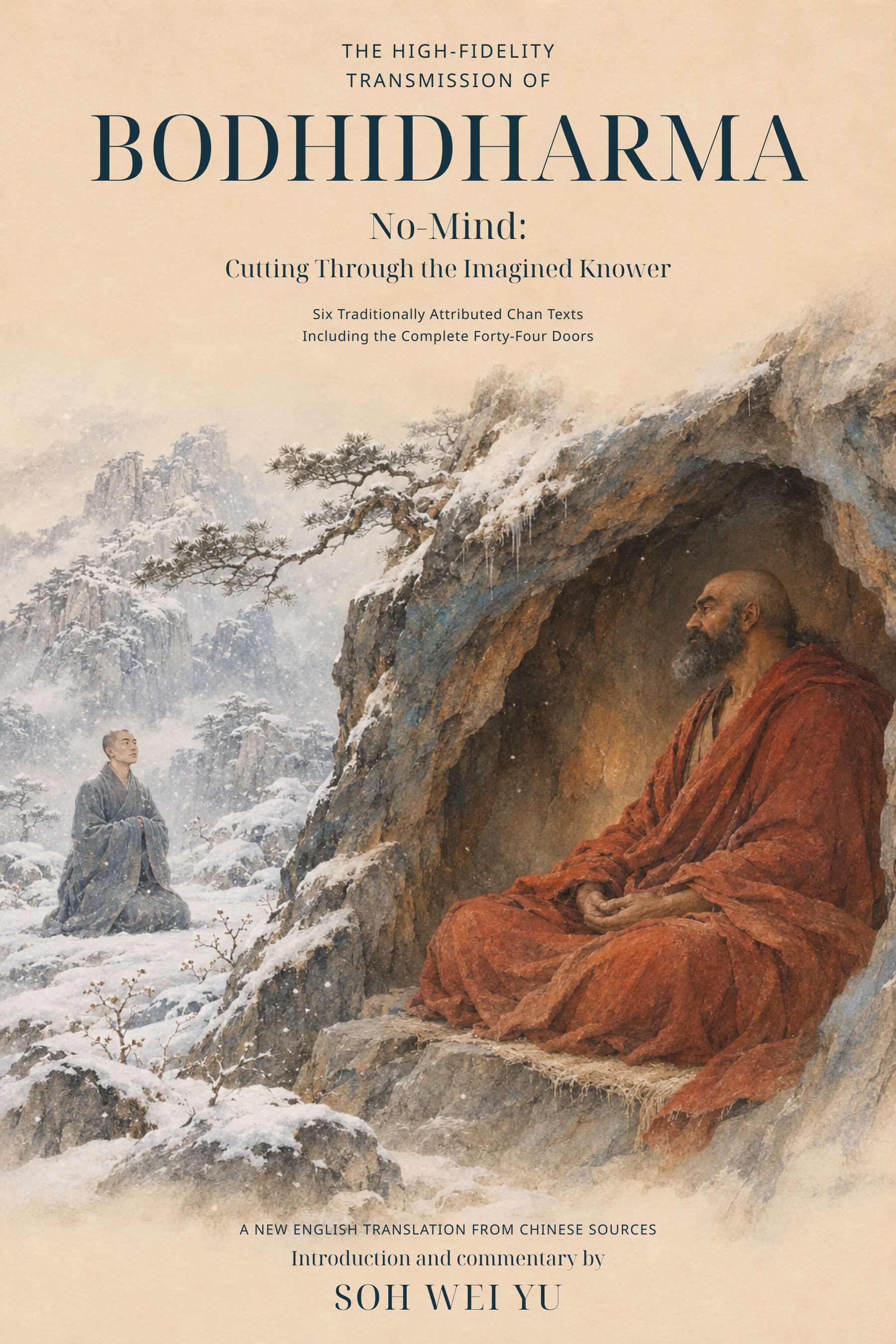
Bodhidharma second-edition front cover
Bodhidharma, second edition. Tap the cover to view the full-size image.

The second edition of The High-Fidelity Transmission of Bodhidharma presents a brand-new retranslation undertaken from the original Chinese texts, integrated with my extended preface, introduction, historical discussions and commentaries. It preserves the complete six-text collection traditionally associated with Bodhidharma, including all Forty-Four Doors.

The historical distinctions matter. A text’s traditional attribution to Bodhidharma and what can be established about its authorship or transmission are separate questions. The revised notes explain those distinctions while keeping the teachings themselves accessible to the reader.

  • Renewed attention to the Chinese wording. The translation and notes have been repeatedly checked against the selected Chinese sources, with corrections where missing distinctions, unclear wording or differences between Chinese versions affected the meaning.
  • Commentary integrated with the new translation. The longer explanations and personal reflections remain in the book, with quotations matched to the revised English text and placed alongside the relevant passages.
  • More careful philosophical and practical distinctions. The revisions clarify discussions of No-Mind, awakening and continuing practice, including the distinction between seeing through self-view and the residual “I am” conceit. Terminology has also been refined, for example distinguishing karma, intentional action, from its ripening.
  • Improved sources and reading aids. Translation notes, historical appendices, bibliography, glossary and cross-references have been reviewed together. Readers can follow the relationship between the translated passage, the Chinese evidence and the commentary more easily.
  • New book design and navigation. The cover, 6 × 9-inch layout, headings, quotations and linked contents have been redesigned. The EPUB lets you adjust the text size and jump to individual works and the Forty-Four Doors.

Huangbo: a new translation with the full commentary

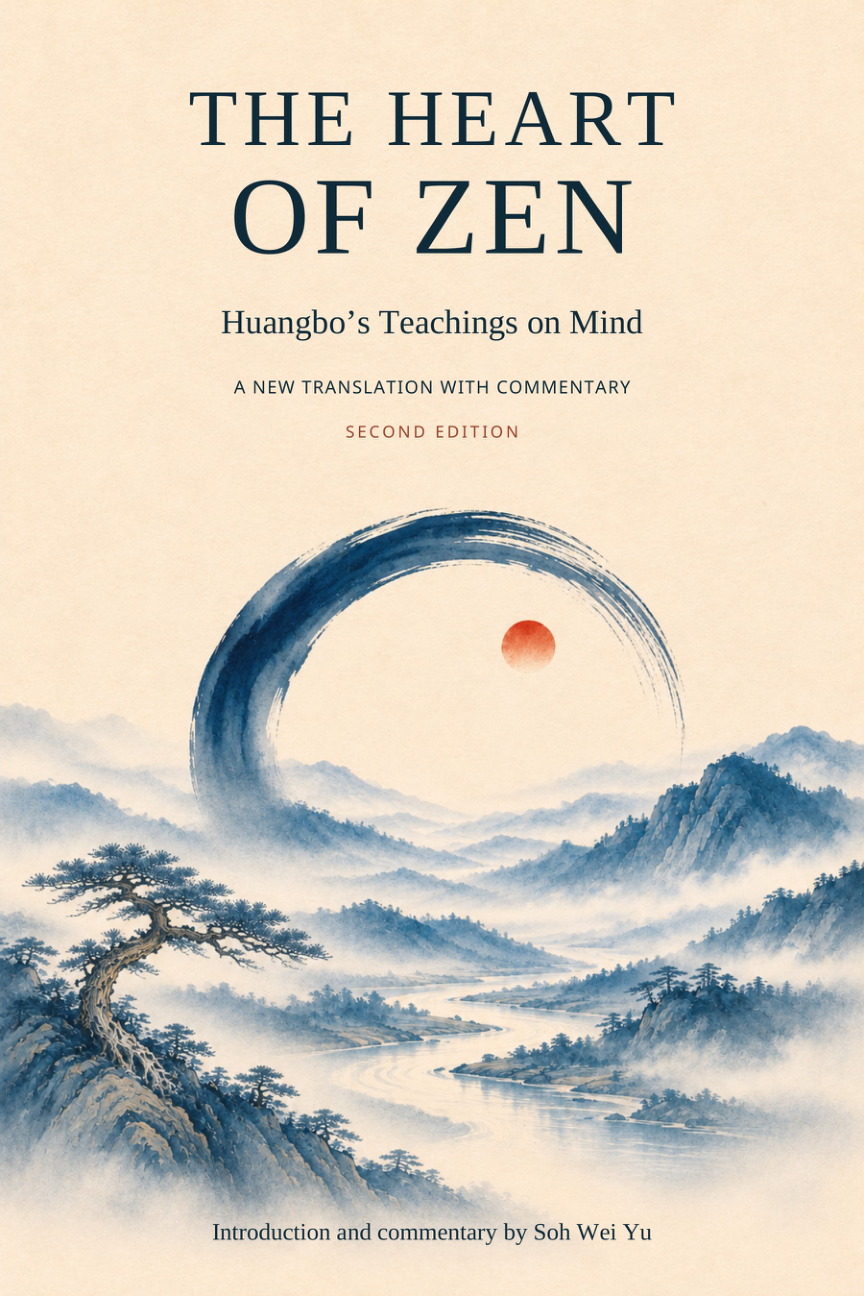
The Heart of Zen, Huangbo second-edition cover
The Heart of Zen, second edition. Tap the cover to view the full-size image.

The second edition of The Heart of Zen presents a brand-new retranslation from the original Chinese, together with the substantive preface, historical discussions, explanations and personal commentaries from my 2025 book. The older English translation has been replaced, while the commentary has been carefully matched to the corresponding passages in the new text.

As in the 2025 edition, the volume includes Pei Xiu’s preface, the Essentials of Mind Transmission, the Wanling Record and its closing verse, and all 28 appended items. Both records and all 28 items were already in the earlier edition. It also retains the source notes and discussion of differences between surviving versions of the Chinese text, so readers can distinguish the selected text from related passages in other records.

Some of the main changes are:

  • Expanded explanation of True Mind, No-Mind and anatta. The commentary gives greater attention to the experiential meaning of these teachings. In describing anatta, I use the formulation “no agent and no background subject,” while emphasizing the vividness of luminous knowingness as the appearances of the six senses.
  • A clearer treatment of non-dual seeing and dependent origination. The mirror and reflection discussion now makes clear that Huangbo’s criticism concerns the seer–seen division. Seeing is not established as a subject reaching out toward an object, yet appearances still arise dependently. Nothing here requires an unchanging consciousness-substance behind experience.
  • The full substantive commentary is retained. This includes my original critique of aspects of Blofeld’s interpretation, the complete John Tan passages discussed in the book, and the associated dialogues and reflections. The quotations remain distinguishable from my explanations.
  • More precise source notes and attribution. Historical claims, the sources of quotations and differences between versions have been checked again. The notes distinguish the source of a passage from similar ideas elsewhere and from later interpretations.
  • A redesigned reading edition. The book has new front and back covers, clearer type, clickable contents, a passage guide and easier links between the text and notes.

Chinese AtR Practice Guide: revised text and a new design

Chinese AtR Practice Guide R247 cover
The Chinese AtR Practice Guide, R247. Simplified and Traditional Chinese downloads are available on the book page.

The Awakening to Reality Practice Guide was compiled and edited by Nafis Rahman, drawing primarily on writings by John Tan and myself. It brings together practical instructions and contemplations from the much longer Awakening to Reality: A Guide to the Nature of Mind.

The revised Chinese edition has been checked against the English guide and relevant sources. The corrections clarify meaning, identify who is speaking, improve quotation accuracy and explain key terms and references.

  • Corrections that affect how the teaching is understood. These include a reversed meaning in a passage discussing experiences of “no body, no mind, no self,” a misidentified passage from Dōgen’s Zenki, and missing or ambiguous dialogue labels.
  • Clearer terminology in context. Added explanations help readers distinguish “One Mind” as used in the AtR stage map from uses of the same expression in Huangbo and other Chan texts. The different contexts are preserved.
  • Restored and better-organized supporting material. The diagram associated with Steven Heine’s discussion has been restored as a diagram redrawn in Chinese, with its source identified. Redundant Bassui passages have been removed, while longer Japanese source passages have been moved to an appendix with return links.
  • A more readable Chinese book. The new 6 × 9-inch design has clearer Chinese type and chapter openings, clearly marked quotations and editorial notes, clickable contents and a short glossary.
  • A new mirror-room cover. Inspired by Yayoi Kusama’s Infinity Mirror Rooms, the lights and reflections evoke Indra’s Net and total exertion. Nafis and I were drawn to this imagery because the whole scene participates in what appears: the lights, reflections, space and viewer together. This is our interpretation of the imagery in relation to the guide.

Special thanks to Nafis for compiling the guide, and to John Tan for the teachings and conversations that run throughout it.

Review and corrections

The full books have been checked and revised repeatedly, with the commentary and source material retained. Mistakes may still remain. If you notice a mistranslation, missing attribution, broken link or other error, please let me know, ideally with the passage and supporting source.

Where to begin

If you are new to AtR, please begin with the recommended reading order and free guides. The practice guide provides a practical introduction to the distinctions between I AM, non-duality, anatta, emptiness and total exertion. The Bodhidharma and Huangbo volumes offer further material for studying and contemplating these teachings in the context of Chan.

I hope these revised editions will be useful in your study and practice.

Soh

Silent Illumination 默照銘

By

Awakening to Reality · Song-dynasty Caodong Chan

Silent Illumination[1]

默照銘 (Mo Zhao Ming)

Text by Song-dynasty Chan Master Hongzhi Zhengjue[2] · Commentary by Zen Master Hong Wen Liang · Chinese original (whole text)

Hongzhi’s verse

Chinese Original: http://greatsupreme.joinbbs.net/viewthread.php?tid=18

English Translation:

Silently forgetting words, bright clarity manifests before you.[3] When reflecting, it is vast and open; in the place of Essence, it is numinous and vivid.

Numinously vivid and singularly illuminating, within the illumination it is yet marvellous. Dew, the moon, stars, and the River; snow, pines, clouds, and peaks.

Obscure yet all the brighter; hidden yet all the more manifest. The crane dreams in the misty cold; the water contains the autumn rhymes.

Limitless kalpas are utterly empty, interconnected and identical.[4] The wondrous presence dwells in the place of Silence; the Function serves within Illumination.

The wondrous presence exists—where does it exist? Vivid alertness shatters dullness. The Way of Silent Illumination is the root of the "separated and the subtle."

Thoroughly seeing the separated and the subtle: a gold shuttle and a jade loom. Upright and Inclined turn gracefully; brightness and darkness depend on one another.[5]

Depending without subject and object, at this time they mutually integrate. Drinking the medicine of Correct View;[6] beating the poison-smeared drum.

At the time of mutual integration, killing and giving life rest with me. Exiting the body from within the gate; bearing fruit upon the branch tips.

Silence alone is the supreme word; Illumination alone is the universal response. Responding without falling into merit; speaking without involving listening.

The myriad phenomena in their density radiate light and expound the Dharma. Each and every one validates; each and every one questions and answers.

Questioning, answering, and validating, they correspond precisely. If Illumination loses Silence, then intrusion is seen.

Questioning, answering, and validating, the correspondence is precise. If Silence loses Illumination, it becomes murky and remains a leftover dharma.

When the Principle of Silent Illumination is perfect, the lotus blossoms and the dream awakens. A hundred rivers go to the ocean; a thousand peaks face the Great Mountain.

Just as a goose selects its nourishment; just as a bee gathers nectar from flowers. When Silent Illumination is supremely attained, the heritage of our School is carried forward.

The Silent Illumination of the Tsung-school penetrates the top and penetrates the bottom. The body of Śūnyatā;[7] the arms of the Mudrā.

Beginning and end are a single principle; changing forms are of ten thousand varieties. Mr. He offering the jade; Xiangru pointing out the flaw.

Fitting the capacity with certainty; the Great Function is not labored. The sky-frame within the domain; the general beyond the frontier.

The matter at the bottom of our house conforms to the compass and ruler. Transmitting it to all directions, do not earn it or hold it up [falsely].

Teacher Hong Wenliang’s Explanation

Silently forgetting words, bright clarity manifests before you

Here, it discusses the Essence of that Essence, Function, Nature, and Appearance. We borrow words; Essence belongs to the place where language is cut off. You talk about it for half a day, but that is not it. This is "forgetting words," where language cannot reach. "Silently" does not mean you sit in meditation[8] not speaking, not moving your thoughts, "Ah... then the wondrous presence manifests, the top of the head gets cool, the buttocks get hot, the qi starts moving"—it does not mean this.[9] This Essence is the place where language is cut off, where the functioning of the mind is extinguished.

"Bright clarity manifests before you" says, "Ha, the myriad phenomena are all its manifestation; a thousand lights appearing as reflections are all it."

When reflecting, it is vast and open; in the place of Essence, it is numinous and vivid.

Here, the meaning is the same; it is a repetition. Its manifestation is "when reflecting"; it is not that you go look at it, and then it manifests as mountains, rivers, stars, the moon, spring, summer, autumn, and winter... Clearly it is spring, clearly it is autumn. "When reflecting, it is vast and open"; anything can manifest, very, very many myriad phenomena. But at its place of Essence, its fundamental nature, it is truly very marvellous. Where is it? We don't know, yet it manifests just like this.

Numinously vivid and singularly illuminating, within the illumination it is yet marvellous.

"Numinously vivid" is the Essence. "Singularly illuminating"—it possesses light in itself; it can reflect itself by itself. It is not that there is an Essence in this place, projecting out like this, and the projected light becomes mountains, water, fish, and birds; it is not like that. Mountains, water, fish, and birds themselves are the manifestation of its own light; this is called "numinously vivid and singularly illuminating." The function of that Essence, the function of the Dharmakāya, is just that formidable. Now you look at me speaking; my appearance, physical form, and voice are the manifestations of your Essence; it is not that there is a "someone" here. However, do not misunderstand; it is not saying that "you" have an Essence. If one says "you" have an Essence, then there is a "my fundamental nature" there, and we easily get duped again immediately... Apart from the Buddhadharma, there is no way to explain this. "'I' have an Essence, 'I' have a fundamental nature"—that fundamental nature seems to belong to me. My Essence—it seems like "I" possess this fundamental nature, and this "I" of yours seems even bigger than the fundamental nature!

"Within the illumination it is yet marvellous." This illumination appears as sound, physical form, or manifests in various shapes. This itself is very marvellous. Why? It turns into physical form, but can simultaneously turn into sound, can manifest as sensation, and can manifest as thought. Isn't it that marvellous within the illumination?

Dew, the moon, stars, and the River; snow, pines, clouds, and peaks.

All of this is a description of "Numinously vivid and singularly illuminating, within the illumination it is yet marvellous."

Next is: day has dawned, ha, the sky brightens but does not reveal. This morning, the sun has come out, the sky is bright, ha, look, look, look... no matter how you look you cannot find it; the sky brightens but does not reveal. What about midnight? It is so distinct! "Obscure yet all the brighter; hidden yet all the more manifest." Do you know the meaning now? "Obscure" refers to that Essence; you simply cannot see it, cannot touch it, and cannot even think of it. However, it manifests so clearly. Sound is just sound, physical form is just physical form. Therefore, "Hidden yet all the more manifest; obscure yet all the brighter" mean the same thing. Right? We can all easily see everyone's appearance, everyone hears the birds singing, the fish in the water swimming back and forth; aren't forms, sounds, scents, flavors, textures, and mental objects very obvious? Where is that Essence? Not a trace of a reflection. Nowhere to abide. "Nowhere to abide" means having no form or shape. However, being "nowhere to abide," it manifests as a thousand lights and reflections; a thousand kinds of light manifest like reflections. Where is it? "Obscure"—you cannot find it. But, if you cannot find it, is it dead and heavy, hard and rigid? Hmm... it manifests in various appearances, including you. You think, "What is my Essence?" That "you" is merely what you are thinking. That Essence is right there moving.

Limitless kalpas are utterly empty, interconnected and identical. The wondrous presence dwells in the place of Silence; the Function serves within Illumination.

Isn't this very marvellous? You can see many things, you can taste many flavors, you can think many thoughts, you can feel many sensations, can't you? In your square-inch [of mind], there are all kinds of marvellous things you haven't seen; once you encounter them, you see them. Things you haven't eaten—you don't need to research them, just put them in your mouth and taste... marvellous! Ultimately, where does this kind of wondrous presence exist? It is not the forms, sounds, scents, flavors, textures, and dharmas themselves; it is not the taste itself. Its various thousands of colors and ten thousand hues are very marvellous. Where does it exist? It exists in a place you cannot see and cannot touch; this is "The wondrous presence dwells in the place of Silence." If you realize the place of Silence, you are enlightened. However, this place of Silence cannot be separated from the "Wondrous presence" of thousands of colors and ten thousand hues. If you leave behind the visible physical forms and the audible sounds to find another marvellous palace elsewhere, or some marvellous God or Buddha, then that is incorrect. Silence is right in the place of the wondrous presence. The wondrous presence is in the place of Silence; they are the same. Where is the wondrous presence? Because you cannot find the source from which it manifests, the wondrous presence is in the place of Silence. However, this place of Silence cannot be separated from Wondrous Presence. The marvellous function of this Silence relies on appearances to manifest. Without appearances, you simply would not understand the Great Function of that Silence. However, that which manifests is not Silence itself. This is called "Borrowing the position to reveal the function"—borrowing this position, one then knows, ah, there is such a great function. Conversely, "Borrowing the function to reveal the position"—borrowing these physical forms, sounds, scents, flavors, textures, and dharmas, the visible, the audible, the ability to think itself—borrowing the function, ah, there must be a source: revealing the position. "Borrowing the function to reveal the position," or "Borrowing the position to reveal the function"—Upadhyaya Zhengjue gave examples. What is "Borrowing the function to reveal the position"? Ha, seeing Dr. Lo, Mr. Fang, hearing insects chirping; right now a breeze is blowing, it's comfortable—these are all functions, manifesting various kinds of functions. Now the mobile phone rings; this is function. Borrowing this thing, one knows there must be a cause for it to be this way. Without a cause, how could physical forms manifest? How could sound manifest? This ear of yours is inherently physical form, concrete matter.

"Borrowing the function to reveal the position"—what did he use to express it? "The dreaming crane rises and the nest is empty." This thousand-year crane wakes up from sleep, rises, flies away, and one looks: its nest is empty. Originally it was sleeping there, and the nest was invisible; as soon as it wakes, ho ho ho, it takes flight, and looking back, the empty nest is there. Borrowing this flying up, one sees its nest. If it hadn't flown up and sat there, its empty nest would be invisible. If it doesn't move, we don't see it. Once it moves, we see the nest; "Borrowing the function to reveal the position." He used this metaphor so it's easier for everyone to think about. Then for "Borrowing the position to reveal the function," what example did he give? Borrowing this position to express the myriad phenomena; this thing is displayed originally like this. This metaphor is difficult. What example can you all think of now? You try to think. That fundamental position is invisible and untouchable, ha, unlike the crane flying away—the crane's flight is easy to use as an example. This Essence is the thing that is "Silently forgetting words"; you cannot even point to it, right? "In the place of Essence, it is numinous and vivid"; that place of Essence, numinous is numinous, but there is simply no way to speak of it. It is very numinous, yet you cannot touch it or see it. Then, to borrow this position to reveal its function, what example to give? Ha, he gave the example of the Northern Dipper [Big Dipper]. He said, "The Dipper's handle lies horizontally and the River [Milky Way] is faint." The Northern Dipper lies there at the edge of the sky; borrowing this position, ha, this Milky Way becomes faint; this is borrowing the position to reveal the appearance of the Milky Way. This is the example given by Upadhyaya Zhengjue. There is another simpler one, without such poetry, more direct; scientists and Indians use this to express this "Borrowing the function to reveal the position, borrowing the position to reveal the function." This example is easier.

"Borrowing the position to reveal the function" is "One Body discerning the Way within Many Bodies." One Body is the Dharmakāya, the Dharma-nature. Many Bodies are the eyes, ears, nose, tongue, body, and mind—the six roots, six functions; each function represents a body. What is the One Body? That which is "Silently forgetting words." What is the One Body doing within the Many Bodies? It is working! The One Body doing things in the eyes is seeing; in the ears, it is hearing. Therefore, discerning the Way is seeing, hearing, smelling, tasting, feeling, and thinking. One Body discerning the Way within Many Bodies is working; it is the position manifesting within the function. The eyes, ears, nose, tongue, body, and mind of the six sense gates—because they must rely on the Dharmakāya. Without the Dharmakāya, they would have no Precepts, Concentration,[10] and Wisdom;[11] they would move chaotically. The eyes would see red as white; the eyes facing you would turn into sound coming down—that would be a disaster! The six roots are always within Precepts, Concentration, and Wisdom. Why? "Many Bodies peacefully dwelling within the One Body"—this is also "Borrowing the function to reveal the position." Because there is the One Body, because that fundamental nature of the Dharmakāya is there, always Precepts, Concentration, and Wisdom, it will absolutely not see incorrectly. Stinky is stinky, fragrant is fragrant; very annoying is very annoying. It is not that once you practice the Way, you don't care about annoying things; it's not like that. Its function itself is that annoying appears as annoying. Why is it so? As it is, this honest; no more, no less; what is there is there, what is not there is not there. Why? It is very much Precepts, Concentration, and Wisdom; this concerns our Dharma-nature. Because there is Precepts, Concentration, and Wisdom, it steadily has "Many Bodies peacefully dwelling within the Same Essence." So, how is the daily life of an enlightened person? It is just Many Bodies peacefully dwelling within the Same Essence. When we are confused, the Many Bodies do not peacefully dwell within the Same Essence. Originally, it is not that Many Bodies do not peacefully dwell within the Same Essence, but we add a false self into it and mess it up.

Compare these two examples everyone. How marvellous are the examples of Chinese poets. Once the Big Dipper lies horizontally, the whole Milky Way becomes cool and refreshing, faint, lying there leisurely; the multitude of stars all turn towards it. Everyone is so "indifferent in their ambition"; using "The Dipper's handle lies horizontally and the River is faint" to express "Many Bodies peacefully dwelling within the Same Essence." And "The dreaming crane rises and the nest is empty"? That is "One Body discerning the Way within Many Bodies." It runs to the eyes to see, runs to the ears to hear, runs to the skin to feel, runs to the mental root to be able to think. Hey, the One Body is very busy inside the Many Bodies. The Many Bodies of eyes, ears, nose, tongue, body, and mind—because they are manifestations of the One Body, they keep Precepts, Concentration, and Wisdom very well: "Peacefully dwelling." It is not "because I practice, I am different from others"; that is Taoist thought.

Therefore, "The wondrous presence dwells in the place of Silence"; Many Bodies peacefully dwelling within the Same Essence is precisely the wondrous presence dwelling in the place of Silence. Therefore, it can manifest just right, no more, no less. Being able to keep Precepts, Concentration, and Wisdom like this is all because it peacefully dwells within the Same Essence; therefore, "The wondrous presence dwells in the place of Silence."

"The Function serves within Illumination." What is Function? Seeing, hearing, tasting... the inherent functions of our six roots. But when your eyes see, you assume "I saw"; is it like that? The inherent functions of our six roots are the true supernatural powers and great functions; they manifest naturally within "Forgotten Illumination." Yet our state is "I am looking at you"; that is not "Forgotten Illumination." "Reflecting while facing conditions" is not Forgotten Illumination. "Reflecting without facing conditions" is "Forgotten Illumination." It is not that you practice and only then it becomes like this, ha. What we inherently possess is "Reflecting without facing conditions." The functions of our six roots simply do not assume "I reflected, I heard, I thought..."; it is never like that. "Forgotten Illumination" does it; it simply does not say "I did it." Our six roots themselves are all "reflecting yet not reflecting"; this is called "Reflecting without facing conditions," also called "Forgotten Illumination." Was this gained by practice? Your fundamental nature is the Buddha-nature[12]; it is just that our inverted delusive thinking, "I have a...", that chaotic thinking messes it up and ruins your fundamental nature, the Buddha-nature. So you go outside to find the Buddha-nature, hoping someone will give it to you, hoping someone will give you empowerment (abhiṣeka). The Buddha-nature is right there with you, yet you still search outside. Not only you; generally those who study Buddhism are all like this. They get "Silently forgetting words" all wrong, thinking it means sitting there, not moving a bit, quieting thoughts as much as possible, breathing, one, two, three, four... counting breaths, anapana... visualization ho ho ho, om ah hum... Doing this in order to "forget words."[13] What is "Silently forgetting words" as spoken by Chan Master Hongzhi? The place of Silence refers to the One Body. "Bright clarity manifests before you" refers to the Many Bodies; eyes, ears, nose, tongue, body, and mind all move. When it reflects, "The Function serves within Illumination"; within the true function of the six roots, it is not that you have practiced very well to be like this. Do you understand this point?

The wondrous presence exists—where does it exist? Vivid alertness shatters dullness.

"The wondrous presence exists—where does it exist?" You keep saying the wondrous presence dwells in the place of Silence, that Many Bodies peacefully dwell within the One Body, so it can exert the various forms of "Dharma abiding in the Dharma-position"—seeing is just seeing, hearing is just hearing, it won't be chaotic. Then what is the situation of "The wondrous presence exists"? "Vivid alertness shatters dullness." Facing you, red is just red, green is just green—"Shattering dullness," na. That wondrous presence, it seems to move, seems not to move. But when it moves, it is not like a stone; it is not dull and heavy like a stone. Our Dharma-nature is lively and vivid. When it moves, its fundamental nature is Many Bodies peacefully dwelling within the Same Essence, so it can be this marvellous. But where is the One Body? You cannot find it.

The Way of Silent Illumination is the root of the "separated and the subtle."

"The Way of Silent Illumination is the root of the 'separated and the subtle'." Silence is the Essence; Illumination is the Function. Its function is "Reflecting without facing conditions, knowing without touching things." What is "Separated"? It means separating from these various forms, sounds, scents, flavors, textures, and dharmas. Red color, fish, birds, cypress trees, cars—aren't they our Dharma-nature? "Separated" means they are not exactly It. They are not exactly It, but cars, the moon, stars, fish, and water cannot be separated from It; it is very "Subtle." If they leave It, they cannot manifest. "Separated and Subtle" is this. "Silent Illumination"—Separated is Silence, "Illumination" is Subtle. Therefore, thoroughly seeing the principle of "Separated and Subtle," the principle of Silent Illumination—"Thoroughly seeing the separated and the subtle"—ha, that movement of yours is living water coming; it softens up. That is "A gold shuttle and a jade loom." If you do not thoroughly see the separated and the subtle, you cannot get through at all; you always think I am seeing, I am hearing, my voice is like this, how is your voice. This way, there is no thorough seeing, so the water dies; it is hard and stiff because you have not thoroughly seen the separated and the subtle.

(The Teacher used dead water and living water addressing Ah Chen. Ah Chen is a fish farmer.) Thoroughly seeing the separated and the subtle makes one immediately lively and vivid. Without thoroughly seeing the separated and the subtle, there is you, me, and him; afflictions will certainly come. You view money as very heavy, view fame as very heavy, grasp them very tightly. Losing your life doesn't matter, you want wealth. If your life is truly about to be lost, that won't do; at this time, you can give up wealth, as long as you can live a little longer, that is better. But when even life cannot be preserved, you hope the next life will be a bit better, that would be okay too. When life cannot be preserved, fame and property can be discarded; knowing these cannot be kept, "Just let me go to Heaven." Look, bargaining. So, thoroughly seeing the separated and the subtle is "A gold shuttle and a jade loom"; it is liberation and ease. If wealth is lost, it is lost. You truly see your own Face; you are not turned around by this appearance at all. This is called "A gold shuttle and a jade loom." This shuttle is made of gold. The loom is our weaving machine, made of jade.

Upright and Inclined turn gracefully; brightness and darkness depend on one another.

"Upright and Inclined turn gracefully." "Upright" is the fundamental position, the Essence. "Inclined" is the various forms, sounds, scents, flavors, textures, and dharmas. These seem like two things existing independently, ha, "Turn gracefully"—Inclined is right within the Upright. What is seen, touched, thoughts moving back and forth—they have never left the center of the Upright. Within the Upright, it borrows the Inclined to reveal its Uprightness. Between Upright and Inclined, its Essence and Function are so marvellous: "The wondrous presence exists—where does it exist? Vivid alertness shatters dullness." Whether fundamental position or inclined position, it is the Essence. All appearances cannot be separated from the Essence, cannot be separated from the King of Majestic Sound, from before the Empty Kalpa.

"Brightness and darkness depend on one another." Do not brightness and darkness rely on each other? Without darkness, there is brightness. Without brightness, darkness manifests. Without brightness, where is darkness? Without darkness, where is brightness? "Brightness and darkness depend on one another"—this principle is not that brightness exists as brightness and darkness exists as darkness, independently of each other; then you are wrong. There is simply no independent brightness or independent darkness. Therefore, the Cantongqi explains "Brightness and darkness depend on one another" like your front and back steps. Left foot forward, right foot back; stepping out, hey, the left foot becomes back, the right foot becomes forward. Which one is actually in front, which one is behind? "Brightness and darkness depend on one another" is just like our walking, right? Without the front foot, the back foot cannot be lifted; without the back foot, the front foot cannot be lifted. In the Cantongqi it says, "Within brightness there is darkness; do not meet it as darkness." Do not hear this and say, "That brightness has darkness inside," and use darkness to look at this darkness, and what is left belongs neither to brightness nor darkness—it is not like that. "Within brightness there is darkness; do not meet it as darkness. Within darkness there is brightness; do not see it as brightness." What is this principle? Do you know? I raise my hand; this raising the hand is brightness, it is "Within brightness there is darkness," but the Essence is always the whole manifestation of Essence, so Essence is darkness—you cannot see it, ha, you know? That appearance—without that fundamental nature, the appearance cannot manifest. Where is the fundamental? You cannot find it, cannot see it. Therefore, within brightness there is darkness. Why is it called darkness? This darkness, with this movement, is at the place of "nowhere to abide"; its trace cannot be seen. Can its trace be seen? The hand moves from here to there. But if, using your brain to think, the hand moves from here to the raised place, you have already fixed a point in space; running from this point to another point. But does space have a fixed point? It is your brain considering that the hand ascended from this place to there; this already uses a huge concept, delusive thinking. From what place to what place? What thing goes to what place? What thing is this? What is a fist? What is a hand? The Four Great Elements have no owner, ha. A point without self-nature goes to a place without self-nature. We consider it your fist; you raised it from here to up there; space is fixed, front and back are fixed, time is fixed—only then do you feel you are raising your hand. When raising the hand, this appearance is clearly raising the hand; within brightness there is darkness, within brightness there is dependence. Depending on what? Depending on darkness, depending on having no trace. There is no trace. If every time you raised your hand, every time you walked, you left traces, it would be a disaster; space would be filled with traces of walking! "The bird flies continuously" (Lancet of Seated Meditation); can you see the trace of the bird's flight? This all explains what we in the Chan School call "Right within that very spot" (ge zhong li xu). You call it Fundamental, call it Appearance. "The spiritual source is bright and pure; branches and streams flow in the dark." "The spiritual source is the Fundamental; branches and streams flowing in the dark means the various things that manifest." He speaks of brightness and darkness inversely; it is the same thing. He says, whether you distinguish Fundamental or Appearance, distinguish Nature and Appearance as different—distinguish or not, it's up to you—as long as you "If one realizes," thoroughly realize "Right within that very spot," that is seeing the Nature. As long as you see the Nature, it doesn't matter if you speak of dividing Nature and Appearance, dividing Fundamental and Derivative, dividing Brightness and Darkness, dividing Subject and Object! As long as you see the Nature. If you thoroughly see "Right within that very spot." "Right within that very spot" is the matter of "Upon seeing the bright star." On this, there is no Fundamental or Derivative, no Nature or Appearance, no Subject or Object. Speaking of subject and object is already strange. Even talking about the Buddha verifying Mahākāśyapa is superfluous. So the Buddhadharma is not hanging there for you to touch and grope for half a day, ha... what thing? Then getting a mouthful of Buddhist terms, speaking of Fundamental and Derivative, Nature and Appearance... Therefore, "Brightness and darkness depend on one another" can also be said as "Fundamental and Derivative rely on each other, Nature and Appearance also rely on each other."

Depending without subject and object, at this time they mutually integrate.

"Depending without subject and object"—depending on what do we have brightness and darkness, Fundamental and Derivative? This dependence has no subject and object. Brightness also has no subject and object; darkness also has no subject and object. Only because dependence has no subject and object can brightness and darkness alternate.

At the time of mutual integration, killing and giving life rest with me.

"At the time of mutual integration," I see, I hear, there is sound, there is physical form; they are all interacting, the myriad phenomena are all interacting.

If you can realize "Right within that very spot," then you are free and at ease, liberated and at ease; not afraid of birth and death, not caring about honor or disgrace. "Killing and giving life rest with me," because you are simply not like dead water, you are living water. Therefore, "At the time of mutual integration," within daily life, laughing, crying, making trouble, shouting, thinking—"The bottom," the fundamental thing has already been realized. "Right within that very spot" has been thoroughly understood; that is "At the time of mutual integration." Then, your life, your walking, standing, sitting, and lying down, conducting yourself and handling affairs—"Killing and giving life rest with me," free and unconstrained. Extremely thin, yet he has not a bit of affliction; very wealthy, yet he is not arrogant with wealth. Poor to the extreme, he doesn't care either; if he starves to death, then he starves to death. Who starves to death? "Killing and giving life rest with me"; it is not telling you to really go "kill."

Silence alone is the supreme word; Illumination alone is the universal response.

We keep saying Silence is the Essence, Illumination is the Appearance. What is called the Fundamental, what is the Dharmakāya? "Silence alone is the supreme word"—the supreme word is where language is cut off, where the functioning of the mind is extinguished; the highest explanation, simply impossible to speak of, impossible to point out, impossible even to think of; therefore this place is "Silence." So the first line "Silently forgetting words" does not mean telling you to sit there, sweeping away thoughts, quietly counting breaths, visualizing, quieting down, quieting down, quiet to the extreme, "Bright clarity manifests before you," ah... the spirit has come out. If explained like this, it completely misunderstands Chan Master Hongzhi's meaning. This "Silence" directly speaks of our Buddha-nature, Dharma-nature. It is all moving at the gates of the six roots. Radiating light and moving the earth at the gates of the six roots. Without it, the gates of the six roots would not be just right, Precepts, Concentration, and Wisdom. However, that is movement, that is just it; the marvel is like this. Because you cannot see where it is? Therefore, "Silence alone is the supreme word; Illumination alone is the universal response." As for "Illumination," when it moves, radiating light and moving the earth, hey... a sound (snap), it is not that I moved here; it is my Dharma-nature moving, moving through this ear; if there is thunder there is thunder, if a car then a car sound; no need to use the brain to say the car is coming and I must listen, ha, the car passes and is still rumbling, no; if it's not there, it's not there.

"Illumination alone is the universal response"; the appropriate sound manifests as sound, the appropriate physical form manifests as physical form; this is called radiating light and moving the earth, this is "universal response." Any time, any place, responding just like this as it really is, is "universal response"; it is not responding sometimes and not responding other times. We listen when we are happy, and ignore when unhappy; but the function of our Essence, the function of our Reward Body and Emanation Body, is "universal response," without deviation, without liking or disliking. That is the false self entering to ignore—then not listening, not looking. "My Chan Master teacher is first class in Taiwan; you, so-and-so Hong, are speaking here, I won't listen," listening but ignoring. But while I am speaking, sound has been entering his ears all along. Its fundamental nature is "Illumination alone is the universal response"; what blocks it is that wounded thing called "I"; this is very formidable, for tens of thousands of kalpas this wound has not healed. Now, Chan Master Hongzhi is curing this, do you know? "Silence alone is the supreme word"—that "Silence," the Dharma-nature body of that "Fundamental," you cannot even talk about it, it is the "supreme word"; the highest explanation is "where language is cut off," that is the true explanation.

Responding without falling into merit; speaking without involving listening.

"Responding without falling into merit"—our Dharma-nature radiates light and moves the earth within the six roots. Facing you, seeing you, over there a frog croaks, a frog sound; over there in the kitchen, if there is sound then sound; it universally responds just as it really is. This responding, the way it moves, "Does not fall into merit." "Hey, I did it, I illuminated, I illuminated a hundred times today, I need to rest a bit"—this is falling into merit.

"Speaking without involving listening"—you listened for half a day but couldn't listen in; that is because it is not spoken with language and words, it has nothing to do with this listening of yours. Did it enter? It was spoken, "Insentient beings expounding the Dharma"—how to listen? So this is "Without involving listening." How can you listen?

Hey, but if there is truly the matter of "Upon seeing the bright star," then one is clearly listening to "Insentient beings expounding the Dharma"; however, this listening is not the kind where ordinary people listen because there is sound. The speech of "Speaking without involving listening" is the speech of "Silence alone is the supreme word"; it is not listening with the meaning of "I heard it" using our ears. "Responding without falling into merit" is not the kind of illumination of "I saw it," but the kind of illumination of "Reflecting without facing conditions." Therefore, when it responds, it is universal response, it is not falling into merit.

Emperor Wu of Liang said to Bodhidharma: "I built many temples and made offerings to many monks; this merit is not small, right?" Bodhidharma answered saying there was not a bit of merit. He was not disparaging Emperor Wu of Liang. He was saying that when your six fundamental natures are functioning, they do not fall into merit! You think there is merit; your sixth consciousness says I am the Emperor, the Emperor does so many good deeds, helping Buddhism; this "I am the Emperor" thing is false, created by chaotic thinking. Actually, you did so many things, but your six roots do not feel even a bit that they did any good deeds; so this is saying "Responding without falling into merit."

The myriad phenomena in their density radiate light and expound the Dharma.

This needs no further explanation. Water is expounding the Dharma, fish are expounding the Dharma, the blue sky and white clouds are all expounding the Dharma; they are all your fundamental nature, radiating light like this right there; radiating light is just the white clouds and blue sky na.

Each and every one validates; each and every one questions and answers. Questioning, answering, and validating, they correspond precisely.

Look at "Each and every one validates"—all insentient beings are expounding the Dharma. Who are the insentient? Your own fundamental nature. "Each and every one questions and answers; questioning, answering, and validating, they correspond precisely"—the actual situation of our six roots is like this.

If Illumination loses Silence, then intrusion is seen.

Ordinary people do not know; "If Illumination loses Silence," they think it is "I saw, I heard," losing the Silence. Within illumination, hearing, thinking of a matter, getting angry—getting angry is also illumination, ha. It's just that within this, you lose Silence; you forget that this is your Dharma-nature radiating light and moving the earth. How is this lost? One inexplicably gives rise to ignorance for a moment, losing Silence, losing the Fundamental. Illumination and Silence are originally one thing; so within illumination, "Hey, I did a good deed"—Silence is lost.

"Then intrusion is seen"—then it goes awry; as soon as a thought moves it goes awry, and it's done for. Taking the perfectly good six roots—your Dharma-nature is there, functioning as the Reward Body and Emanation Body—yet within illumination, "Hey, I am looking, I am listening..."—Silence is thus lost, becoming "Then intrusion is seen"; you have afflictions coming, cannot sleep at night, everything comes.

Questioning, answering, and validating, the correspondence is precise.

The corresponding function of our six roots—seeing, hearing, tasting spicy as spicy, sweet as sweet—is "Validating, questioning, and answering, corresponding precisely." The sound of a frog will absolutely not be heard as the sound of a car; however big is however big, however small is however small; if it doesn't call, it doesn't call; just do not lose Silence within Illumination.

"Annoying, I am listening to Dr. Hong Wenliang speaking now..."—Silence is lost. Even if you get angry, how can ears get angry? Ears do not lose Silence at all within Illumination. We are originally like this; it is not that you practice and only then do not lose Silence within Illumination, ha. This is the Caodong School, the true Buddhadharma transmitted by the Buddha; it is not that you practice and only then do not lose Silence within Illumination. Your six roots originally move like this; it's just that you add an "I am looking, I am listening..." and thus problems arise.

When the Principle of Silent Illumination is perfect, the lotus blossoms and the dream awakens.

"When the Principle of Silent Illumination is perfect"—between this Silence and Illumination, Nature and Appearance, Subject and Object, Essence and Branch—this Principle is perfect, complete, originally the same as the Great Void, lacking nothing and having no excess. This Principle is very perfect; using reasoning is useless, no matter how one thinks, one cannot conceive of its perfection. At this time, if you realize this—"Ha, originally we are like this..."—personally, ha, not using the brain, using consciousness to say we are originally like this; that is your thinking, you have not yet realized and entered. "We are originally like this"—this is your thought, which is losing Silence within Illumination. What is Illumination? Understanding this principle, then "I illuminated it"—is this Silence? There is simply no Silence. "Losing Silence within Illumination" is precisely the error. Then when "The Principle is perfect within Illumination," naturally "The lotus blossoms and the dream awakens." The lotus has blossomed, the Mind-flower, it is your true fundamental nature. Lotus blossoming is the dream awakening. Therefore, when a person is truly thoroughly awakened, that is a Buddha, apprehending Mind and seeing Nature. That fundamental nature moves right there with you; you just need to personally realize this; do not use reasoning to say we are originally like this; you are simply not moving in that original manner. At this time, if the lotus blossoms and the dream awakens, ah, then birth and death simply cannot disturb you, ha. We think I am living, fear my dying; that one who has lost Silence feels I am very lovable, feels I cherish, want to live a bit more—that is losing Silence within Illumination, not the lotus blossoming and the dream awakening, do you know? Suffering is suffering, pain is pain, bad luck is bad luck; being insulted is being insulted, being held high is also just like this.

A hundred rivers go to the ocean; a thousand peaks face the Great Mountain. Just as a goose selects its nourishment; just as a bee gathers nectar from flowers.

At this time, the lotus blossoms and the dream awakens, ah, at this time, "A hundred rivers go to the ocean; a thousand peaks face the Great Mountain," is a description of that "Just as a goose selects its nourishment"—in the past, highly skilled geese all selected milk [from water]. "Just as a bee gathers nectar from flowers"—like a bee gathering nectar, what does it mean? You have never lost Silence within Illumination; in daily life, laughing the same, crying the same, drinking wine the same, singing the same, playing and having fun with everyone the same. Hey... you look like you are enlightened; strange, why don't you wear a kāṣāya, keep a straight face, and wave that stick around there? Hey... he is just like a goose selecting milk, like a bee gathering nectar; right on top of his true self, he laughs, walks, laughs, ai-yo pain is also it.

When Silent Illumination is supremely attained, the heritage of our School is carried forward.

That true essential asset of Silent Illumination, "Supremely attained," Silent Illumination is truly very subtle; it is explained to you by our Caodong Chan School, contributed to you; this is my "School's heritage." "School's heritage" is actually what the Buddha truly wants to give to people of the world, "Truly just like this ha..." is the School's heritage. It does not refer to some Chan Sect; it is the Buddha's true essential purport, which is Silent Illumination.

Penetrates the top and penetrates the bottom.

Very thorough. Hey, now hearing it, "Penetrates the top and penetrates the bottom"—where does the sound come from? Is this a frog? No, it is a cricket. Is it Silent Illumination? Sound moves here, only then do you know there is sound; strange ne, where does sound come from? Cannot hear, sound disappears; where does it disappear to? Don't know ha. Comes from nowhere, goes nowhere; when there is sound, where does the sound stay in you? Sound must be moving there, only then do you know there is movement. I ask you, sound moves on your Dharma Body; where on your Dharma Body? You don't know, cannot see it.

Silence—is there no sound? There is, Illumination. The Way of separated and subtle, the root of separated and subtle—can you speak of that Dharma-nature? Dharma-nature is that cricket sound moving right there with you; where is that Dharma-nature, Dharma Body? What color? Big or small? Light or heavy? Green color, blue color? "Silence alone is the supreme word." "Speaking without involving listening." Look, here it comes again, the cricket comes to argue with me again. Ears not prepared to listen, there is sound then heard; where from? Where does sound come from? We generally say transmitted from over there to here; which side is over there? Without passing through the ear's nerves, it wouldn't be heard; when the ear's nerves are transmitting, isn't that sound? When not transmitting, it is not sound; when those nerves are changing there, you cannot say that is not sound ha. Is the change of nerves sound? That is change; then what is sound? Running from where to where? I ask you. But, if there is, there is; Silent Illumination. "When Silent Illumination is supremely attained," if you want to make it clear, you are done for. If you want to illuminate, want to know, hey, the problem comes!

Let us briefly explain some key points again. The key point is actually the first one: "Silently forgetting words, bright clarity manifests before you," it is all like this. However, do not treat this as hurrying to sit in meditation, getting rid of thoughts, emptying the mind, a patch of sunny brightness, not thinking, sweeping thoughts clean. Forget you are sitting there in meditation, ha... if you can't forget, you use breath counting, one, two, three, four... quiet to the extreme, ah... I have realized, "Bright clarity manifests before you"—what thing has manifested? A ghost shadow manifesting!? You say manifest, there must be an image, a state manifesting. Could it be the appearance of Guanyin that counts? Could it be that a pure state counts? That arising and ceasing dharma, originally nonexistent; sitting there quietly, it manifests; isn't that illuminated out? Telling people to sit in meditation like this is finished, off by a hundred and eight thousand miles; so everyone hearing this kind of teaching wants to make the mind quiet. Hey... the mind is messy; the six roots originally have always been in Silent Illumination, always without interruption; it is that false self interfering, intrude. Who intrude? Your own delusive thinking. I ask you, you say now "I am listening," is there this "I"? "I am here listening to your lecture," "I am listening to the cricket sound." If this "I" were real, and you now think non-stop: "I am you, I am you, I am you..." keep thinking, will you turn into me? Will you? You keep thinking "I am you...", think for ten thousand years, it is still this "I" of your own; you won't turn into the you that you are thinking of, right? Therefore you know this "I I I" and "I am you" are the same, like reflections; what "I" is there! It is you thinking it is "I," but this is formidable; because of habit, for tens of millions of kalpas it has been this habit. You exchange like this, and you will know, hey, this thing is truly strange; I am working hard here, it must be that "I" moving a bit, moving a bit; if that were true, you exchange this "I" for "you," "I am you," you think it over carefully, will this thing turn into you? It is still that appearance; that appearance is not nonexistent, it exists! But calling it "I" is incorrect!

Notes

Brief terminology and source-wording notes. Terms not present verbatim in the supplied English source are identified as such; the author’s English paragraphs have not been rewritten.

  1. Silent illumination (默照). 默照 (mòzhào) joins 默, “silent,” and 照, “illumination” or “illuminating.” This phrase names Hongzhi’s teaching; it should not be reduced to making the mind blank. The title of the Chinese work is 默照銘. ↩
  2. Hongzhi Zhengjue (宏智正覺). Hongzhi Zhengjue (宏智正覺, 1091–1157) was the Song-dynasty Caodong Chan master associated with 默照銘. “Hongzhi” in the speech is the same figure; he is distinct from the modern commentator Hong Wen Liang. ↩
  3. Hongzhi’s “silent and illuminating” (editorial gloss). “Silent and illuminating” describes the paired 默 (silence) and 照 (illumination) in 默照; it is not an independently quoted line from the poem. The opening actually reads 默默忘言,昭昭現前 (“silently forgetting words; bright clarity manifests before you”). ↩
  4. Emptiness (śūnyatā). “Utterly empty” corresponds here to 浩劫空空. Emptiness (空性, śūnyatā) is not a blank state or an independent substance; in Buddhist usage it points to the absence of intrinsic nature. The English body says “utterly empty” rather than the noun “emptiness.” ↩
  5. Dependent origination (缘起). 缘起 (pratītyasamutpāda) refers to arising in dependence on conditions, not “dependent existence” of already self-established entities. This note accompanies the verse’s “brightness and darkness depend on one another” (明暗因依); it does not claim that the English phrase “dependent origination” occurs here or that every ordinary use of “depend” is the technical term. ↩
  6. “Correct View” and 善見藥. The verse reads 飲善見藥. Here 善見藥 is the name of a legendary healing medicine, invoked as an image for dispelling afflictions and paired with the poison-smeared drum. It is not the Eightfold Path technical term 正見 (“right view”), nor is 善見 here a direct occurrence of 知见 (the AtR house term for doctrinal “view”). The controlling English phrase “Drinking the medicine of Correct View” is preserved exactly; the medicinal allusion is explained here to avoid mistaking the wording for a direct exposition of right view. ↩
  7. Śūnyatā and mudrā (舜若多身,母陀羅臂). Hongzhi’s line reads 舜若多身,母陀羅臂. 舜若多 transliterates śūnyatā (“emptiness”), but Buddhist sources also use 舜若多神 for a space-deity figure; 母陀羅 transliterates mudrā (“seal” or ritual hand gesture). The image therefore carries traditional allusions beyond a literal philosophical statement about “the body of emptiness.” The English wording “The body of Śūnyatā; the arms of the Mudrā” remains unchanged. ↩
  8. Zazen (坐禪). Zazen means “seated meditation” (坐禪). The term zazen is not written in the supplied English body; this note is attached to its first discussion of sitting. The speaker explicitly warns here against equating silence with merely sitting without speech or thoughts. ↩
  9. Shikantaza (只管打坐). Shikantaza is the Japanese Sōtō practice term for “just sitting.” It is historically associated with the Caodong/Sōtō legacy of silent illumination, but the extent of direct equivalence is debated. The speaker does not use this term; his criticism here concerns mistaking a forced absence of thoughts for realization, not a definition of shikantaza. ↩
  10. Samādhi (三昧 / 定). Samādhi names meditative collectedness or concentration (三昧, and in this threefold training context 定). The source phrase is “Precepts, Concentration, and Wisdom” (戒、定、慧). The transliteration “samadhi” does not occur verbatim in the English body. ↩
  11. Prajñā (般若 / 慧). Prajñā means wisdom or insight (般若; here, 慧 in the triad 戒、定、慧). This note marks the first occurrence of “Wisdom” in that triad. “Prajna” itself is not a word in the English body. ↩
  12. Buddha-nature (佛性). 佛性 (fóxìng), Buddha-nature, is the technical term. The speaker cautions against imagining that a separate “you” possesses an Essence as an object. The English discussion and its distinction between the false “I” and Buddha-nature are left unchanged. ↩
  13. Hua-tou (話頭). 話頭 (huàtóu, “critical phrase” or “head of a saying”) is used for inquiry in 看話禪 (kanhua Chan). It differs from the breath counting and visualization just mentioned. The speaker does not name or teach hua-tou here; this is a distinction between methods, not an attribution. ↩

English house edition · Source text and commentary reproduced without rewriting; explanatory notes are editorial.

The AtR Dharma Library

Must Reads

New here? Begin with Seven Stages, then On Anatta. Explore the full collection below.

View full list on page →

New in the AtR library

Latest posts

Up to 20 recent articles, newest publication first.

Browse more posts below.

Browse more posts →

AtR Library

Browse books, articles, recordings and ways to follow AtR.

Continue reading

Your unfinished long articles on this device.

    Start Here →Recommended readings and the free AtR guides John Tan’s Website
    Free Books
      View section on page →
      Featured Articles
        View section on page →
        Audio & Video
          View section on page →
          Further Reading
            View section on page →
            Follow Awakening to Reality
              View section on page →
              Full library on page

              Search AtR

              Examples: anatta · I AM · emptiness · dependent origination · Zen · Mahamudra · Dzogchen

              Try Google for broader results

              Google searches this site in a new tab.