
From Awakening to Reality: A Guide to the Nature of Mind
“To me anatta stanza is still the best trigger… lol. It allows us to clearly see anatta is the natural state. Always is and effortlessly so. It shows "how ignorance" blinds and creates misconceptions of separation and substantiality of what we called "things and phenomena".
And realising the view is all pointing to this truth of anatta from top to bottom of how the mind confuses and mistakens conventional existence as true and real. Dependent origination and emptiness are the raft to balance and neutralize all mind-made conventionalities, so that the mind can rest in natural ease and balance, seeing all arising as spontaneously perfected.” - John Tan, 2019
“Insight that 'anatta' is a seal and not a stage must arise to further progress into the 'effortless' mode. That is, anatta is the ground of all experiences and has always been so, no I. In seeing, always only seen, in hearing always only sound and in thinking, always only thoughts. No effort required and never was there an 'I'.” - John Tan, 2009
“The 2 stanzas below are pivotal in leading me to the direct experience of no-self. Although they appear to convey the same stuff about anatta, meditating on these 2 stanzas can yield 2 very different experiential insights -- one on the emptiness aspect and the other, the non-dual luminosity aspect. The insights that arise from these experiences are very illuminating as they contradict so much our ordinary understanding of what awareness is.” - John Tan, 2009
~ Stanza one
There is thinking, no thinker
There is hearing, no hearer
There is seeing, no seer
The lack of doership that links and coordinates experiences
“Without the 'I' that links, phenomena (thoughts, sound, feelings and so on and so forth) appear bubble-like, floating and manifesting freely, spontaneously and boundlessly. With the absence of the doer-ship also comes a deep sense of freedom and transparency. Ironical as it may sound but it's true experientially. We will not have the right understanding when we hold too tightly 'inherent' view. It is amazing how 'inherent' view prevents us from seeing freedom as no-doership, interdependence and interconnectedness, luminosity and non-dual presence.” - John Tan, 2009
“A thought is "Unsupported" because it does not arise in dependence upon anything else, not "caused" by another thought ("mind-objects") and of course not "produced" by a thinker, which the Bodhisattva realizes does, not exist. Such an "unsupported thought", then, is prajña, arising by itself nondually… ...He began by drawing the following diagram:
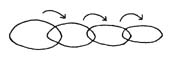
Each oval represents a thought, he said; normally, we leave one thought only when we have another one to go to (as the arrows indicate), but to think in this way constitutes ignorance. Instead, we should realize that thinking is actually like this:
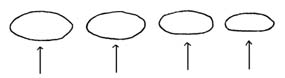
Then we will understand the true nature of thoughts: that thoughts do not arise from each other but by themselves.” ~ Zen teacher David Loy, Nondual Thinking
Rather than saying thought is "not dependent", I think it is better to put it this way:
“[1:20 PM, 10/2/2019] John Tan: DO [dependent origination] and the idea of substantialist cause and effect is different. Arise in dependence cannot be said to be causeless/uncaused or caused. That is why it is the middle path. So we say arise in dependence.”
“Is there in you an entity which you call the 'I' or the 'mind' or the 'self'? Is there a co- ordinator who is co-ordinating what you are looking at with what you are listening to, what you are smelling with what you are tasting, and so on? Or is there anything which links together the various sensations originating from a single sense -- the flow of impulses from the eyes, for example? Actually, there is always a gap between any two sensations. The co-ordinator bridges that gap: he establishes himself as an illusion of continuity.
In the natural state there is no entity who is coordinating the messages from the different senses. Each sense is functioning independently in its own way. When there is a demand from outside which makes it necessary to coordinate one or two or all of the senses and come up with a response, still there is no co-ordinator, but there is a temporary state of coordination. There is no continuity; when the demand has been met, again there is only the uncoordinated, disconnected, disjointed functioning of the senses. This is always the case. Once the continuity is blown apart -- not that it was ever there; but the illusory continuity -- it's finished once and for all.
Can this make any sense to you? It cannot. All that you know lies within the framework of your experience, which is of thought. This state is not an experience. I am only trying to give you a 'feel' of it, which is, unfortunately, misleading.
When there is no co-ordinator, there is no linking of sensations, there is no translating of sensations; they stay pure and simple sensations. I don't even know that they are sensations. I may look at you as you are talking. The eyes will focus on your mouth because that is what is moving, and the ears will receive the sound vibrations. There is nothing inside which links up the two and says that it is you talking. I may be looking at a spring bubbling out of the earth and hear the water, but there is nothing to say that the noise being heard is the sound of water, or that that sound is in any way connected with what I am seeing. I may be looking at my foot, but nothing says that this is my foot. When I am walking, I see my feet moving -- it is such a funny thing: "What is that which is moving?"
What functions is a primordial consciousness, untouched by thought.” - U.G. Krishnamurti, U.G. Krishnamurti: The Mystique of Enlightenment“Let's say it will be noticed that the body is out of shape. A thought may arise that the body could do with some exercise. Next a decision to go to the gym could come up. Nowhere in this 'chain of events' is there the need for an entity that takes the decision. If there was such an entity, it first would have to decide to take such a decision to be able to claim 'authorship.' It also would have to decide to decide to decide ad infinitum, thus creating an infinite regress.
What I always say is that non-doership does not mean that you are helpless, but that the 'you-agent' is fictitious. We say "I live, I think, I breathe" and so on but living, thinking and breathing is not done by someone; it happens by itself.
Let's have a look at thinking: Is there really a 'thinker of thoughts' independent of thought? Does this 'thinker' know what the next thought will be? Or is the thought only known when it comes along? This thought may get claimed in the next thought, which could goes something like "Oh, I just thought about such and such". But is the 'I' claiming to be the thinker of the thought- not itself part of the thought?
Do not take this too literally please, as there actually isn't even a 'next thought'; only this thought right now. There is no past, which has led up to this moment. There is only THIS; including memories and other apparent evidence for such a past.
Nevertheless, there is the unfolding of this dream in which "the Tao, without doing anything, leaves nothing undone." As such there may be the appearance of doing exercises, making decisions, planning your day, falling asleep, waking up, gazing at the stars, reading these words, or registering the sounds around you. It all happens by itself. As the Zen saying goes:
Sitting quietly, doing nothing,
Spring comes, and the grass grows by itself.” - Leo Hartong
“What Leo said is experientially there but in terms of understanding there is a great difference from that of Buddhism. You must go deeper and arise the insight of anatta and dependent origination.
"There is no thinker, just thoughts". A practitioner must not only see that there is "no agent", he must also see the "just thoughts". 'Thought' not as a passing phenomenon and nothing to care about but thought as pristine, luminous, non-dual, emptiness, its dependent originated nature and powerful imprints it can cause leading to the understanding of actions and tendencies rolling on. The best part is when 'tendency' is experienced in conventional sense it appears 'so solidly real'. Only when emptiness nature is directly experienced does reality becomes dream-like.
There are 4 important insights a practitioner must have on the experience of anatta:
The no doership leading to a spontaneous arising experience. Though spontaneous, it is not by 'nature' or 'haphazard'; with the presence of conditions, the arising is spontaneous.
The absence of an agent leading to a 'direct' experience of phenomena. A non-dual experience that dissolve the subject/object split.
No doer but there is doing and leading to the understanding of imprints and actions.
The impermanence and manifestation that leads to the understanding of arising due to conditions. The no-self nature of dependent origination that is free from the view based on who, where and when.
Buddhism is not exactly the union or co-arising of subjective witness and objective phenomena but rather the inseparability of luminosity and emptiness, appearances and conditions.
Do not take this too literally please, as there actually isn't even a 'next thought'; only this thought right now. There is no past, which has led up to this moment. There is only THIS; including memories and other apparent evidence for such a past.
This is an experiential glimpse of non-arising in Buddhism, try to go beyond the 'now' teaching and understand the emptiness nature even this moment of Presence.
There is just this actual moment, which is a thought. Not arising from anywhere or going anywhere. There is even no “right now”, no timeline; free from the dream of the 3 times and resting entirely in this actual phenomena which is, a thought. Arising and ceasing is an appearance, the nature of clarity is non-arising, always just this: a moment, a thought, a witnessing, an action, yet empty!
Nevertheless, there is the unfolding of this dream in which "the Tao, without doing anything, leaves nothing undone." As such there may be the appearance of doing exercises, making decisions, planning your day, falling asleep, waking up, gazing at the stars, reading these words, or registering the sounds around you. It all happens by itself. As the Zen saying goes:
Sitting quietly, doing nothing,
Spring comes, and the grass grows by itself.
Although there is no authorship, it is also not 'helplessness'. There is no doer but there is doing. Free from the 2 extremes, karma and dependent origination are taught.
To progress further, you must understand the differences and experience it directly.” - John Tan, 2009, in response to Leo’s statement above
The direct insight of the absence of an agent
“In this case, there is a direct recognition that there is “no agent”. Just one thought then another thought. So it is always thought watching thought rather than a watcher watching thought. However the gist of this realization is skewed towards a spontaneous liberating experience and a vague glimpse of the empty nature of phenomena -- that is, the transient phenomena being bubble-like and ephemeral, nothing substantial or solid. At this phase we should not misunderstand that we have experienced thoroughly the ‘empty’ nature of phenomena and awareness, although there is this temptation to think we have. -:)
Depending on the conditions of an individual, it may not be obvious that it is “always thought watching thought rather than a watcher watching thought.” or "the watcher is that thought."” - John Tan, 2009
“In the article on https://www.awakeningtoreality.com/2009/03/on-anatta-emptiness-and-spontaneous.html, I mentioned about the 2 stanza. There is the no-agent aspect and there is the intensity of luminosity aspect. I find that your present experience is still centered on the luminosity aspect. You are directly experiencing seamlessness of any happening where no clear line of demarcation can be drawn between the subject-object split. You realized the boundary is purely illusionary and is clear about the cause that resulted in such
division but still, that is not the ‘essence’ of an experiential insight of anatta in my opinion. There is a difference in saying "there is no split between thinking and thinker, the thinking itself is 'me'" and "there is thinking, no thinker". You must be aware that having immediate and direct experience but with dualistic framework intact and complete replacement of the dualistic framework entirely with DO (dependent origination) yields very different experiential insight; you may want to investigate further and move from "they are all flowing independently" to "manifesting in seamless inter-dependencies." - John Tan, 2010
“In the Vajrayana there is the direct path to examining mind. In everyday life we are habituated to thinking, "I have a mind and I perceive these things." Ordinarily, we do not directly look at the mind and therefore do not see the mind. This is very strange because we see things and we know that we are seeing visual phenomena. But who is seeing? We can look directly at the mind and find that there is no one seeing; there is no seer, and yet we are seeing phenomena. The same is true for the mental consciousness. We think various thoughts, but where is that thinking taking place? Who or what is thinking? However, when we look directly at the mind, we discover that there is nobody there; there is no thinker and yet thinking is going on. This approach of directly looking in a state of meditation isn't one of reasoning, but of directly looking at the mind to see what is there.” - Thrangu Rinpoche, Thrangu Rinpoche on Nature of Mind
“Alan Watts: ...Upon reflection, there seems to be nothing unreasonable in seeing the world in this way. The agent behind every action is itself action. If a mat can be called matting, a cat can be called catting. We do not actually need to ask who or what "cats," just as we do not need to ask what is the basic stuff or substance out of which the world is formed---for there is no way of describing this substance except in terms of form, of structure, order, and operation…
André A. Pais "The agent behind every action is itself action".
Great insight.
John Tan Therefore it is the action that knows, no knower.
Manage” - Alan Watts: Agent and Action
~ Stanza two
In thinking, just thoughts
In hearing, just sounds
In seeing, just forms, shapes and colors.
Direct realization of luminosity/radiance as the very vividness of forms and textures
of transience beyond subject/object division.
“Division of subject and object is merely an assumption.
Thus someone giving up and something to be given up is an illusion.
When self becomes more and more transparent,
Likewise phenomena become more and more luminous.
In thorough transparency all happening are pristinely and vividly clear.
Obviousness throughout, aliveness everywhere!” - John Tan, 2009
“(9:14 PM) Thusness: when we talk about Buddha’s teachings, the essence should be so: the electricity [analogy used to represent consciousness] should not be taken as an entity. The organs are part of the conditions for manifestations. When condition arises, it is the luminosity of the appearances that you must know. You never see or know what awareness is unless through conditions where appearances manifest, that vividness of appearance is awareness in real time and life… ...not what i see glows, it is the seeing is the object is the awareness” - John Tan, 2007
“In the seen, there is just the seen! It is completely non-dual... there is no 'the seen + a perceiver here seeing the seen'.... The seen is precisely the seeing! There is not two or three things: seer, seeing, and the seen. That split is entirely conceptual (though taken to be reality)... it is a conclusion due to a referencing back of a direct experience (like a sight or a sound) to a centerpoint.” - Soh Wei Yu, 2010, My commentary on Bahiya Sutta
“...We don’t need to bring our awareness anywhere -
awareness is always within the arising
of the experience itself.
We don’t need to make any separation
between bodily sensations and awareness.
Bodily sensations are already awareness.
Thought is already awareness.
We don’t need to bring
awareness to the thought.
What we’re exploring
is not the body
but the body’s awareness.
We’re just exploring
the body of awareness…” - Charles Genoud, Gesture of Awareness
“...have adequate experience of the vividness, realness and presence of Awareness and the full experience of these qualities in the transience. Without which it will not be easy to realize that "the arising and passing sensations are the very awareness itself." A balance is therefore needed, otherwise practitioners may experience equanimity but skew towards dispassion and lack realization.“ - John Tan, 2009, Emptiness as Viewless View and Embracing the Transience
"The key towards pure knowingness is to bring the taste of presence into the 6 entries and exits. So that what is seen, heard, touched, tasted are pervaded by a deep sense of crystal, radiance and transparency. This requires seeing through the center." - John Tan
“...Similarly, regarding whatever is in the field of the tactile sense organ, such things as fabrics that are soft or rough to the touch, this tactile sensation itself is your own mind. Avoid slipping into grasping or rejecting. Whether soft or rough, do not try to find the mind anywhere apart from the softness or roughness itself, but rest at ease right there without distraction. If a pleasant or an unpleasant feeling arises, recognize it and rest mindfully.
…
Lord Gotsangpa said:
"In general, the apparent myriad of phenomena is one’s own mind. Since phenomena and emptiness have never been abiding as two separate entities, there is no need to restrain cognizance within."
Also:
"When there is an appearance of a form in the field of the eyes, that appearance of form itself is one’s mind; the apparent form and emptiness are not two. By resting gently right on the form without grasping, subject and object become naturally liberated. The same applies to sounds, smells, tastes, textures, as well as mental occurrences: by resting on the occurrence itself, it becomes self-liberated. That is to say, instead of meditating on cognizance, by meditating without grasping right on the outer objects of the six sense perceptions, the six senses arise as meditation and enhancement will ensue."” - Self-Liberation by Khamtrul Rinpoche III
“When you look into a thought's identity, without having to dissolve the thought and without having to force it out by meditation, the vividness of the thought is itself the indescribable and naked state of aware emptiness. We call this seeing the natural face of innate thought or thought dawns as dharmakaya.
…
"When you vividly perceive a mountain or a house, no matter how this perception appears, it does not need to disappear or be stopped. Rather, while this perception is experienced, it is itself an intangible, empty awareness. This is called seeing the identity of perception."
"Previously you cleared up uncertainties when you looked into the identity of a perception and resolved that perceptions are mind. Accordingly, the perception is not outside and the mind is not inside…” - Resolving That Thoughts and Perceptions are Buddha-Mind
“Hi Mr. J, Despite all differences we may have about lower yanas, no practices needed, Absolute…I really appreciate your zealous attempt to bring this message into view and I agree with you wholeheartedly on this aspect of “transmission”. If one truly wants this essence to be “transmitted”, how can it be otherwise? For what that is to be passed is truly of different dimension, how can it be adulterated with words and forms? The ancient teachers are extremely serious observing and waiting for the right condition to pass the essence unreservedly and wholeheartedly. So much so that when the essence is transmitted, it must boil the blood and penetrate deep into the bone marrow. The entire body-mind must become one opening eye. Once open, everything turns “spirit”, mind intellect drops and what’s left is aliveness and intelligence everywhere! Mr. J, I sincerely hope you well, just don’t leave trace in the Absolute. Gone! :)” - John Tan, 2013
“Ok... I am seeing your point as "awareness" outside of conditioned experience is an imputation. When could one ever have such an experience outside of experience? The "knowing" of being would also be an experience, as opposed to the "not knowing". And if there was "not knowing", then how you could prove there was "awareness" in such a "not knowing"? Very interesting.
Well, its not really new... it is just clear now how there is an imputation we put on Awareness as being "separate' from experience, as some sort of "stand alone" awareness". I have always experienced awareness as experience inseparably so, but didn't notice the subtle imputation that gives still a separate implication of being a remainder, when all things are absent. Being wouldn't know itself outside of experience. If being did know itself in total voidness, that very "knowing" would itself be an experience, hence the void would not be void. God cannot be separated from creation, because the potential for creation is already Known.” - Mr. J, 2012
“What is presence now? Everything... Taste saliva, smell, think, what is that? Snap of a finger, sing. All ordinary activity, zero effort therefore nothing attained. Yet is full accomplishment. In esoteric terms, eat God, taste God, see God, hear God...lol. That is the first thing I told Mr. J few years back when he first messaged me 😂 If a mirror is there, this is not possible. If clarity isn't empty, this isn't possible. Not even slightest effort is needed. Do you feel it? Grabbing of my legs as if I am grabbing presence! Do you have this experience already? When there is no mirror, then entire existence is just lights-sounds-sensations as single presence. Presence is grabbing presence. The movement to grab legs is Presence.. the sensation of grabbing legs is Presence.. For me even typing or blinking my eyes. For fear that it is misunderstood, don't talk about it. Right understanding is no presence, for every single sense of knowingness is different. Otherwise Mr. J will say nonsense... lol. When there is a mirror, this is not possible. Think I wrote to longchen (Sim Pern Chong) about 10 years ago.” - John Tan
“An interesting comment Jax. After realization… Just eat God, breathe God, smell God and see God… Lastly be fully unestablished and liberate God.” - John Tan, 2012
(Soh: Lest readers misinterpret that John is affirming a substantialist notion of a ‘God’, it should be noted that by the phase of Anatta realization, there is simply no more reifications or conceivings of a metaphysical ‘God’ or ‘Creator’ of any kind, and John was simply using the lingo of Mr. J to convey the complete absence of a background substratum of Presence and the total luminosity of Presencing-as-manifestation to Mr. J using Mr. J’s ‘esoteric lingo’. Even the word ‘Presence’ is not referring to some static entity here - ‘Presencing’ is perhaps a better term, for as James M. Corrigan wrote, “...Awareness is not something other than the “presencing” (i.e. naturing) of appearances. It is not a thing. It is not part of a thing. It is not an “aspect” of a process… ...it is the process—not some aspect of it”
Before reading this chapter, make sure to read the article On Anatta (No-Self), Emptiness, Maha and Ordinariness, and Spontaneous Perfection by John Tan. Consider this section a summary and additional commentary for the original article. When both stanzas of anatta are completely realized as always already so, that is John Tan Stage 5.
“To me anatta stanza is still the best trigger… lol. It allows us to clearly see anatta is the natural state. Always is and effortlessly so. It shows "how ignorance" blinds and creates misconceptions of separation and substantiality of what we called "things and phenomena".
And realising the view is all pointing to this truth of anatta from top to bottom of how the mind confuses and mistakens conventional existence as true and real. Dependent origination and emptiness are the raft to balance and neutralize all mind-made conventionalities, so that the mind can rest in natural ease and balance, seeing all arising as spontaneously perfected.” - John Tan, 2019
“Insight that 'anatta' is a seal and not a stage must arise to further progress into the 'effortless' mode. That is, anatta is the ground of all experiences and has always been so, no I. In seeing, always only seen, in hearing always only sound and in thinking, always only thoughts. No effort required and never was there an 'I'.” - John Tan, 2009
“The 2 stanzas below are pivotal in leading me to the direct experience of no-self. Although they appear to convey the same stuff about anatta, meditating on these 2 stanzas can yield 2 very different experiential insights -- one on the emptiness aspect and the other, the non-dual luminosity aspect. The insights that arise from these experiences are very illuminating as they contradict so much our ordinary understanding of what awareness is.” - John Tan, 2009
~ Stanza one
There is thinking, no thinker
There is hearing, no hearer
There is seeing, no seer
The lack of doership that links and coordinates experiences
“Without the 'I' that links, phenomena (thoughts, sound, feelings and so on and so forth) appear bubble-like, floating and manifesting freely, spontaneously and boundlessly. With the absence of the doer-ship also comes a deep sense of freedom and transparency. Ironical as it may sound but it's true experientially. We will not have the right understanding when we hold too tightly 'inherent' view. It is amazing how 'inherent' view prevents us from seeing freedom as no-doership, interdependence and interconnectedness, luminosity and non-dual presence.” - John Tan, 2009
“A thought is "Unsupported" because it does not arise in dependence upon anything else, not "caused" by another thought ("mind-objects") and of course not "produced" by a thinker, which the Bodhisattva realizes does, not exist. Such an "unsupported thought", then, is prajña, arising by itself nondually… ...He began by drawing the following diagram:
Each oval represents a thought, he said; normally, we leave one thought only when we have another one to go to (as the arrows indicate), but to think in this way constitutes ignorance. Instead, we should realize that thinking is actually like this:
Then we will understand the true nature of thoughts: that thoughts do not arise from each other but by themselves.” ~ Zen teacher David Loy, Nondual Thinking
Rather than saying thought is "not dependent", I think it is better to put it this way:
“[1:20 PM, 10/2/2019] John Tan: DO [dependent origination] and the idea of substantialist cause and effect is different. Arise in dependence cannot be said to be causeless/uncaused or caused. That is why it is the middle path. So we say arise in dependence.”
“Is there in you an entity which you call the 'I' or the 'mind' or the 'self'? Is there a co- ordinator who is co-ordinating what you are looking at with what you are listening to, what you are smelling with what you are tasting, and so on? Or is there anything which links together the various sensations originating from a single sense -- the flow of impulses from the eyes, for example? Actually, there is always a gap between any two sensations. The co-ordinator bridges that gap: he establishes himself as an illusion of continuity.
In the natural state there is no entity who is coordinating the messages from the different senses. Each sense is functioning independently in its own way. When there is a demand from outside which makes it necessary to coordinate one or two or all of the senses and come up with a response, still there is no co-ordinator, but there is a temporary state of coordination. There is no continuity; when the demand has been met, again there is only the uncoordinated, disconnected, disjointed functioning of the senses. This is always the case. Once the continuity is blown apart -- not that it was ever there; but the illusory continuity -- it's finished once and for all.
Can this make any sense to you? It cannot. All that you know lies within the framework of your experience, which is of thought. This state is not an experience. I am only trying to give you a 'feel' of it, which is, unfortunately, misleading.
When there is no co-ordinator, there is no linking of sensations, there is no translating of sensations; they stay pure and simple sensations. I don't even know that they are sensations. I may look at you as you are talking. The eyes will focus on your mouth because that is what is moving, and the ears will receive the sound vibrations. There is nothing inside which links up the two and says that it is you talking. I may be looking at a spring bubbling out of the earth and hear the water, but there is nothing to say that the noise being heard is the sound of water, or that that sound is in any way connected with what I am seeing. I may be looking at my foot, but nothing says that this is my foot. When I am walking, I see my feet moving -- it is such a funny thing: "What is that which is moving?"
What functions is a primordial consciousness, untouched by thought.” - U.G. Krishnamurti, U.G. Krishnamurti: The Mystique of Enlightenment“Let's say it will be noticed that the body is out of shape. A thought may arise that the body could do with some exercise. Next a decision to go to the gym could come up. Nowhere in this 'chain of events' is there the need for an entity that takes the decision. If there was such an entity, it first would have to decide to take such a decision to be able to claim 'authorship.' It also would have to decide to decide to decide ad infinitum, thus creating an infinite regress.
What I always say is that non-doership does not mean that you are helpless, but that the 'you-agent' is fictitious. We say "I live, I think, I breathe" and so on but living, thinking and breathing is not done by someone; it happens by itself.
Let's have a look at thinking: Is there really a 'thinker of thoughts' independent of thought? Does this 'thinker' know what the next thought will be? Or is the thought only known when it comes along? This thought may get claimed in the next thought, which could goes something like "Oh, I just thought about such and such". But is the 'I' claiming to be the thinker of the thought- not itself part of the thought?
Do not take this too literally please, as there actually isn't even a 'next thought'; only this thought right now. There is no past, which has led up to this moment. There is only THIS; including memories and other apparent evidence for such a past.
Nevertheless, there is the unfolding of this dream in which "the Tao, without doing anything, leaves nothing undone." As such there may be the appearance of doing exercises, making decisions, planning your day, falling asleep, waking up, gazing at the stars, reading these words, or registering the sounds around you. It all happens by itself. As the Zen saying goes:
Sitting quietly, doing nothing,
Spring comes, and the grass grows by itself.” - Leo Hartong
“What Leo said is experientially there but in terms of understanding there is a great difference from that of Buddhism. You must go deeper and arise the insight of anatta and dependent origination.
"There is no thinker, just thoughts". A practitioner must not only see that there is "no agent", he must also see the "just thoughts". 'Thought' not as a passing phenomenon and nothing to care about but thought as pristine, luminous, non-dual, emptiness, its dependent originated nature and powerful imprints it can cause leading to the understanding of actions and tendencies rolling on. The best part is when 'tendency' is experienced in conventional sense it appears 'so solidly real'. Only when emptiness nature is directly experienced does reality becomes dream-like.
There are 4 important insights a practitioner must have on the experience of anatta:
The no doership leading to a spontaneous arising experience. Though spontaneous, it is not by 'nature' or 'haphazard'; with the presence of conditions, the arising is spontaneous.
The absence of an agent leading to a 'direct' experience of phenomena. A non-dual experience that dissolve the subject/object split.
No doer but there is doing and leading to the understanding of imprints and actions.
The impermanence and manifestation that leads to the understanding of arising due to conditions. The no-self nature of dependent origination that is free from the view based on who, where and when.
Buddhism is not exactly the union or co-arising of subjective witness and objective phenomena but rather the inseparability of luminosity and emptiness, appearances and conditions.
Do not take this too literally please, as there actually isn't even a 'next thought'; only this thought right now. There is no past, which has led up to this moment. There is only THIS; including memories and other apparent evidence for such a past.
This is an experiential glimpse of non-arising in Buddhism, try to go beyond the 'now' teaching and understand the emptiness nature even this moment of Presence.
There is just this actual moment, which is a thought. Not arising from anywhere or going anywhere. There is even no “right now”, no timeline; free from the dream of the 3 times and resting entirely in this actual phenomena which is, a thought. Arising and ceasing is an appearance, the nature of clarity is non-arising, always just this: a moment, a thought, a witnessing, an action, yet empty!
Nevertheless, there is the unfolding of this dream in which "the Tao, without doing anything, leaves nothing undone." As such there may be the appearance of doing exercises, making decisions, planning your day, falling asleep, waking up, gazing at the stars, reading these words, or registering the sounds around you. It all happens by itself. As the Zen saying goes:
Sitting quietly, doing nothing,
Spring comes, and the grass grows by itself.
Although there is no authorship, it is also not 'helplessness'. There is no doer but there is doing. Free from the 2 extremes, karma and dependent origination are taught.
To progress further, you must understand the differences and experience it directly.” - John Tan, 2009, in response to Leo’s statement above
The direct insight of the absence of an agent
“In this case, there is a direct recognition that there is “no agent”. Just one thought then another thought. So it is always thought watching thought rather than a watcher watching thought. However the gist of this realization is skewed towards a spontaneous liberating experience and a vague glimpse of the empty nature of phenomena -- that is, the transient phenomena being bubble-like and ephemeral, nothing substantial or solid. At this phase we should not misunderstand that we have experienced thoroughly the ‘empty’ nature of phenomena and awareness, although there is this temptation to think we have. -:)
Depending on the conditions of an individual, it may not be obvious that it is “always thought watching thought rather than a watcher watching thought.” or "the watcher is that thought."” - John Tan, 2009
“In the article on https://www.awakeningtoreality.com/2009/03/on-anatta-emptiness-and-spontaneous.html, I mentioned about the 2 stanza. There is the no-agent aspect and there is the intensity of luminosity aspect. I find that your present experience is still centered on the luminosity aspect. You are directly experiencing seamlessness of any happening where no clear line of demarcation can be drawn between the subject-object split. You realized the boundary is purely illusionary and is clear about the cause that resulted in such
division but still, that is not the ‘essence’ of an experiential insight of anatta in my opinion. There is a difference in saying "there is no split between thinking and thinker, the thinking itself is 'me'" and "there is thinking, no thinker". You must be aware that having immediate and direct experience but with dualistic framework intact and complete replacement of the dualistic framework entirely with DO (dependent origination) yields very different experiential insight; you may want to investigate further and move from "they are all flowing independently" to "manifesting in seamless inter-dependencies." - John Tan, 2010
“In the Vajrayana there is the direct path to examining mind. In everyday life we are habituated to thinking, "I have a mind and I perceive these things." Ordinarily, we do not directly look at the mind and therefore do not see the mind. This is very strange because we see things and we know that we are seeing visual phenomena. But who is seeing? We can look directly at the mind and find that there is no one seeing; there is no seer, and yet we are seeing phenomena. The same is true for the mental consciousness. We think various thoughts, but where is that thinking taking place? Who or what is thinking? However, when we look directly at the mind, we discover that there is nobody there; there is no thinker and yet thinking is going on. This approach of directly looking in a state of meditation isn't one of reasoning, but of directly looking at the mind to see what is there.” - Thrangu Rinpoche, Thrangu Rinpoche on Nature of Mind
“Alan Watts: ...Upon reflection, there seems to be nothing unreasonable in seeing the world in this way. The agent behind every action is itself action. If a mat can be called matting, a cat can be called catting. We do not actually need to ask who or what "cats," just as we do not need to ask what is the basic stuff or substance out of which the world is formed---for there is no way of describing this substance except in terms of form, of structure, order, and operation…
André A. Pais "The agent behind every action is itself action".
Great insight.
John Tan Therefore it is the action that knows, no knower.
Manage” - Alan Watts: Agent and Action
~ Stanza two
In thinking, just thoughts
In hearing, just sounds
In seeing, just forms, shapes and colors.
Direct realization of luminosity/radiance as the very vividness of forms and textures
of transience beyond subject/object division.
“Division of subject and object is merely an assumption.
Thus someone giving up and something to be given up is an illusion.
When self becomes more and more transparent,
Likewise phenomena become more and more luminous.
In thorough transparency all happening are pristinely and vividly clear.
Obviousness throughout, aliveness everywhere!” - John Tan, 2009
“(9:14 PM) Thusness: when we talk about Buddha’s teachings, the essence should be so: the electricity [analogy used to represent consciousness] should not be taken as an entity. The organs are part of the conditions for manifestations. When condition arises, it is the luminosity of the appearances that you must know. You never see or know what awareness is unless through conditions where appearances manifest, that vividness of appearance is awareness in real time and life… ...not what i see glows, it is the seeing is the object is the awareness” - John Tan, 2007
“In the seen, there is just the seen! It is completely non-dual... there is no 'the seen + a perceiver here seeing the seen'.... The seen is precisely the seeing! There is not two or three things: seer, seeing, and the seen. That split is entirely conceptual (though taken to be reality)... it is a conclusion due to a referencing back of a direct experience (like a sight or a sound) to a centerpoint.” - Soh Wei Yu, 2010, My commentary on Bahiya Sutta
“...We don’t need to bring our awareness anywhere -
awareness is always within the arising
of the experience itself.
We don’t need to make any separation
between bodily sensations and awareness.
Bodily sensations are already awareness.
Thought is already awareness.
We don’t need to bring
awareness to the thought.
What we’re exploring
is not the body
but the body’s awareness.
We’re just exploring
the body of awareness…” - Charles Genoud, Gesture of Awareness
“...have adequate experience of the vividness, realness and presence of Awareness and the full experience of these qualities in the transience. Without which it will not be easy to realize that "the arising and passing sensations are the very awareness itself." A balance is therefore needed, otherwise practitioners may experience equanimity but skew towards dispassion and lack realization.“ - John Tan, 2009, Emptiness as Viewless View and Embracing the Transience
"The key towards pure knowingness is to bring the taste of presence into the 6 entries and exits. So that what is seen, heard, touched, tasted are pervaded by a deep sense of crystal, radiance and transparency. This requires seeing through the center." - John Tan
“...Similarly, regarding whatever is in the field of the tactile sense organ, such things as fabrics that are soft or rough to the touch, this tactile sensation itself is your own mind. Avoid slipping into grasping or rejecting. Whether soft or rough, do not try to find the mind anywhere apart from the softness or roughness itself, but rest at ease right there without distraction. If a pleasant or an unpleasant feeling arises, recognize it and rest mindfully.
…
Lord Gotsangpa said:
"In general, the apparent myriad of phenomena is one’s own mind. Since phenomena and emptiness have never been abiding as two separate entities, there is no need to restrain cognizance within."
Also:
"When there is an appearance of a form in the field of the eyes, that appearance of form itself is one’s mind; the apparent form and emptiness are not two. By resting gently right on the form without grasping, subject and object become naturally liberated. The same applies to sounds, smells, tastes, textures, as well as mental occurrences: by resting on the occurrence itself, it becomes self-liberated. That is to say, instead of meditating on cognizance, by meditating without grasping right on the outer objects of the six sense perceptions, the six senses arise as meditation and enhancement will ensue."” - Self-Liberation by Khamtrul Rinpoche III
“When you look into a thought's identity, without having to dissolve the thought and without having to force it out by meditation, the vividness of the thought is itself the indescribable and naked state of aware emptiness. We call this seeing the natural face of innate thought or thought dawns as dharmakaya.
…
"When you vividly perceive a mountain or a house, no matter how this perception appears, it does not need to disappear or be stopped. Rather, while this perception is experienced, it is itself an intangible, empty awareness. This is called seeing the identity of perception."
"Previously you cleared up uncertainties when you looked into the identity of a perception and resolved that perceptions are mind. Accordingly, the perception is not outside and the mind is not inside…” - Resolving That Thoughts and Perceptions are Buddha-Mind
“Hi Mr. J, Despite all differences we may have about lower yanas, no practices needed, Absolute…I really appreciate your zealous attempt to bring this message into view and I agree with you wholeheartedly on this aspect of “transmission”. If one truly wants this essence to be “transmitted”, how can it be otherwise? For what that is to be passed is truly of different dimension, how can it be adulterated with words and forms? The ancient teachers are extremely serious observing and waiting for the right condition to pass the essence unreservedly and wholeheartedly. So much so that when the essence is transmitted, it must boil the blood and penetrate deep into the bone marrow. The entire body-mind must become one opening eye. Once open, everything turns “spirit”, mind intellect drops and what’s left is aliveness and intelligence everywhere! Mr. J, I sincerely hope you well, just don’t leave trace in the Absolute. Gone! :)” - John Tan, 2013
“Ok... I am seeing your point as "awareness" outside of conditioned experience is an imputation. When could one ever have such an experience outside of experience? The "knowing" of being would also be an experience, as opposed to the "not knowing". And if there was "not knowing", then how you could prove there was "awareness" in such a "not knowing"? Very interesting.
Well, its not really new... it is just clear now how there is an imputation we put on Awareness as being "separate' from experience, as some sort of "stand alone" awareness". I have always experienced awareness as experience inseparably so, but didn't notice the subtle imputation that gives still a separate implication of being a remainder, when all things are absent. Being wouldn't know itself outside of experience. If being did know itself in total voidness, that very "knowing" would itself be an experience, hence the void would not be void. God cannot be separated from creation, because the potential for creation is already Known.” - Mr. J, 2012
“What is presence now? Everything... Taste saliva, smell, think, what is that? Snap of a finger, sing. All ordinary activity, zero effort therefore nothing attained. Yet is full accomplishment. In esoteric terms, eat God, taste God, see God, hear God...lol. That is the first thing I told Mr. J few years back when he first messaged me 😂 If a mirror is there, this is not possible. If clarity isn't empty, this isn't possible. Not even slightest effort is needed. Do you feel it? Grabbing of my legs as if I am grabbing presence! Do you have this experience already? When there is no mirror, then entire existence is just lights-sounds-sensations as single presence. Presence is grabbing presence. The movement to grab legs is Presence.. the sensation of grabbing legs is Presence.. For me even typing or blinking my eyes. For fear that it is misunderstood, don't talk about it. Right understanding is no presence, for every single sense of knowingness is different. Otherwise Mr. J will say nonsense... lol. When there is a mirror, this is not possible. Think I wrote to longchen (Sim Pern Chong) about 10 years ago.” - John Tan
“An interesting comment Jax. After realization… Just eat God, breathe God, smell God and see God… Lastly be fully unestablished and liberate God.” - John Tan, 2012
(Soh: Lest readers misinterpret that John is affirming a substantialist notion of a ‘God’, it should be noted that by the phase of Anatta realization, there is simply no more reifications or conceivings of a metaphysical ‘God’ or ‘Creator’ of any kind, and John was simply using the lingo of Mr. J to convey the complete absence of a background substratum of Presence and the total luminosity of Presencing-as-manifestation to Mr. J using Mr. J’s ‘esoteric lingo’. Even the word ‘Presence’ is not referring to some static entity here - ‘Presencing’ is perhaps a better term, for as James M. Corrigan wrote, “...Awareness is not something other than the “presencing” (i.e. naturing) of appearances. It is not a thing. It is not part of a thing. It is not an “aspect” of a process… ...it is the process—not some aspect of it”


.png)


